[Korean: Madeo] 마더
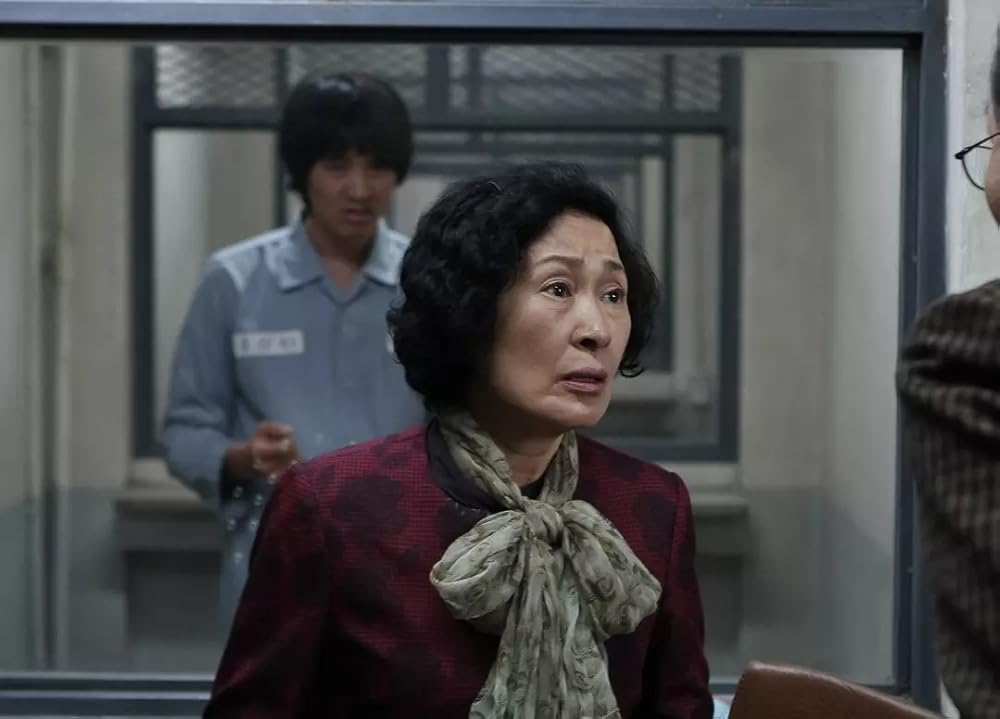
(Kim Hye-ja, Won Bin, Jin Goo, Moon Hee-ra, Yoon Je-moon. Directed by Bong Joon-ho.)
This is a murder mystery, but it’s also more than that. The video below analyzes how Mother led to director Bong’s Parasite (2019), with spoilers for both movies. The video says:
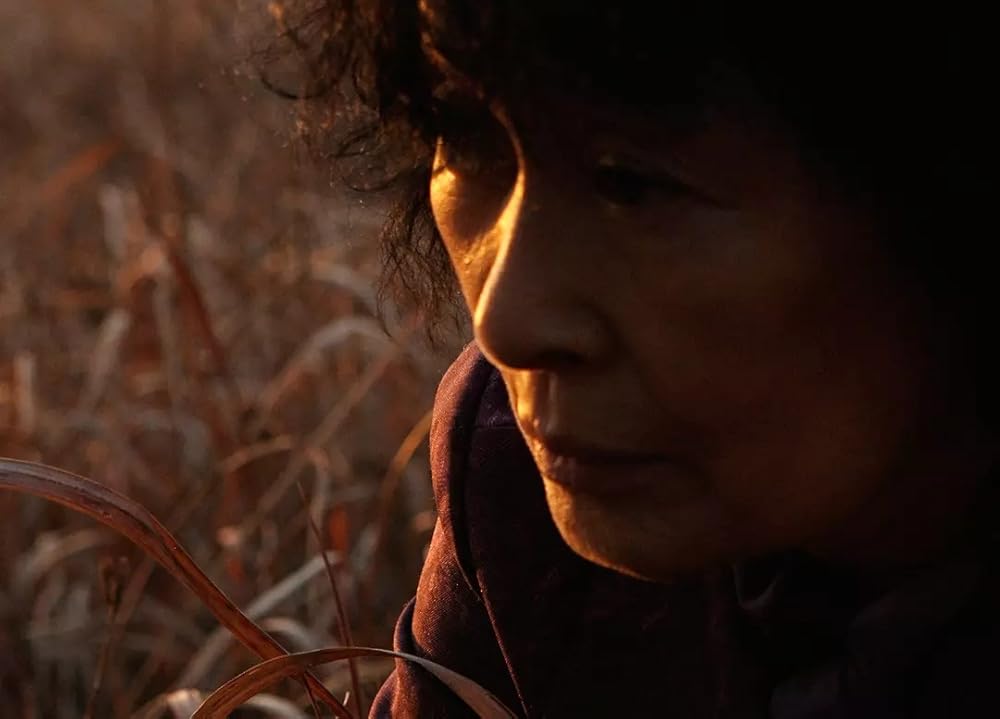
Mother, in its briefest form, is about a woman who tries to save her only son, with intellectual disability, from being imprisoned. … From what feels like a very typical genre film premise, Bong Joon-ho creates something extraordinary, a film that … leaves [viewers] in shock and awe.
(Sally Hawkins, Eddie Marsan, Alexis Zegerman, Sylvestra Le Touzel, Samuel Roukin. Directed by Mike Leigh.)
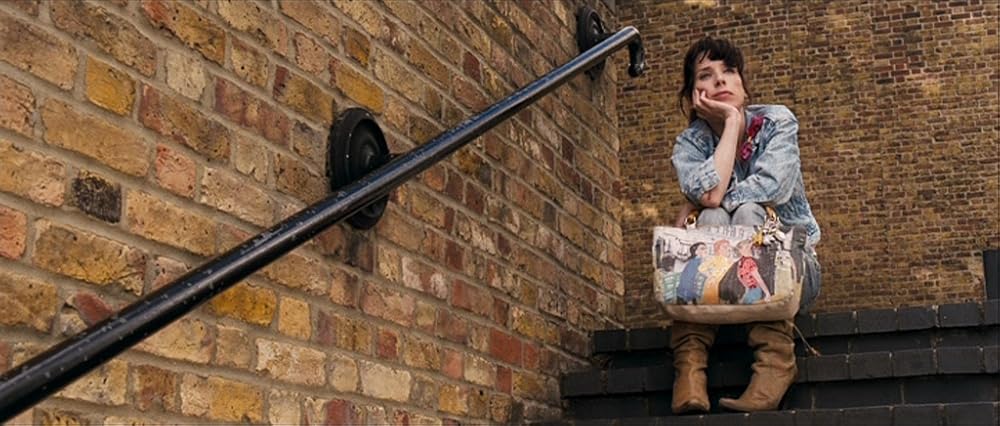
This British dramedy directed by Mike Leigh is about a 30-year-old teacher (Sally Hawkins) who’s so unwaveringly cheerful that when she realizes her bike has been stolen, she doesn’t get angry; she just wistfully says: “Didn’t even get a chance to say goodbye!” She whimsically goes through life as if it were a cartoon, but there’s more to her underneath her goofy surface. …
In that scene, she tries to draw out her driving instructor:
Did you like school, Scott?
I’m afraid it didn’t agree with me.
Oh, that’s a shame. …
The education system, it works like this: I will give you a worldview, and if you repeat my worldview, if you reconfirm my worldview, you will pass your exams, and you will go higher and higher and higher. And you will become a policeman, a magistrate, a lawyer, a general, a politician. And you will be happy, and you will succeed. But if you think for yourself, if you think outside of the box, then you will be unhappy, and you will fail. … Left turn. …
Were you bullied at school, Scott?
Do the next left turn. …
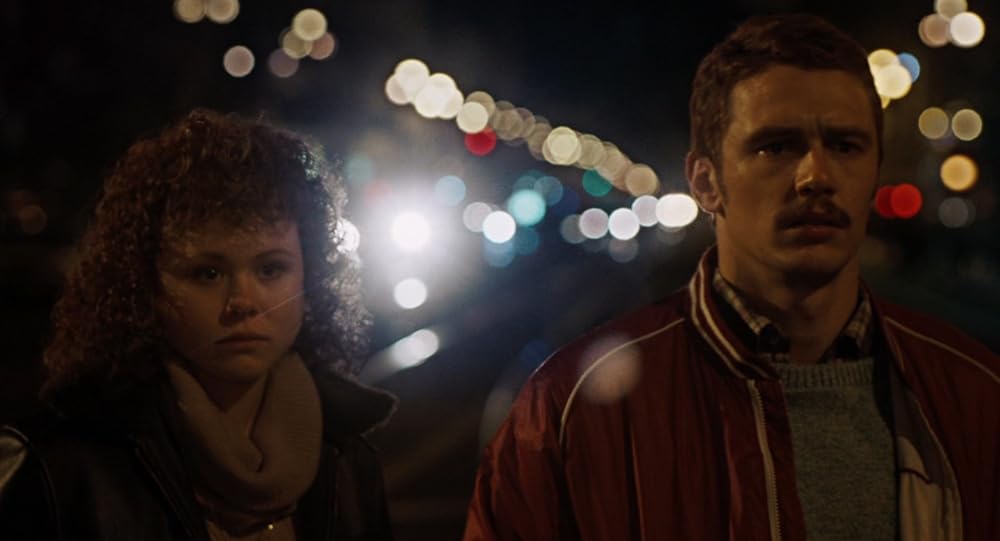
2. Blending recreated historical scenes with archival footage of historical events.
3. Recreating the look and feel of the 1970s. …
6. Artistic representation of assassination. …
8. A serious drama that creates surprising empathy for a character who doesn’t deserve it and is not the hero of the story.
(U2. Directed by Catherine Owens, Mark Pellington.)
I saw this 3D movie in an IMAX theater twice. A message at the beginning warned us that the music would be played at about the same volume as a real concert. It was like seeing U2 live, but being able to fly right up to the band members.
4 Months implicitly evokes the insidious creep of a police state so intrusive you can’t even check into or out of a hotel without someone in uniform demanding to know why you’re there and what time you’re coming back. Moving through ill-lit streets from their dingy college dorm to the shabby room that has drained their meager budget, the two young women find themselves continually stymied by arbitrary rules and regulations whose only point seems to be to reduce them to dependent children, unable to think for themselves and browbeaten into submission by officials wielding petty power — and by the sheer effort it takes to get through the day.
As with all dictatorships, such oversight overload creates a breeding ground for bribery, corruption, and black markets in everything, from Western soap and cigarettes to that dangerously late abortion itself, carried out by an unlicensed amateur [Vlad Ivanov] in the next worst thing to a back alley.
A movie producer named Bob Hawk describes the feeling of this movie (in a video that’s been taken down from YouTube):
It’s an extraordinary portrait of friendship that is tested, simply because of what they both have to put themselves through. The tension in this film is so extraordinary. I remember vividly the experience of first seeing it in a packed house. When you have hundreds of people in a room, and you can hear a pin drop, it’s a great compliment. And it is earned. The film has a lot of long takes. It’s not chopped up by a lot of editing. And you are kind of captive to time. And it’s not letting you off the hook. It immerses you.
Stream 4 Months, 3 Weeks and 2 Days on these sites.
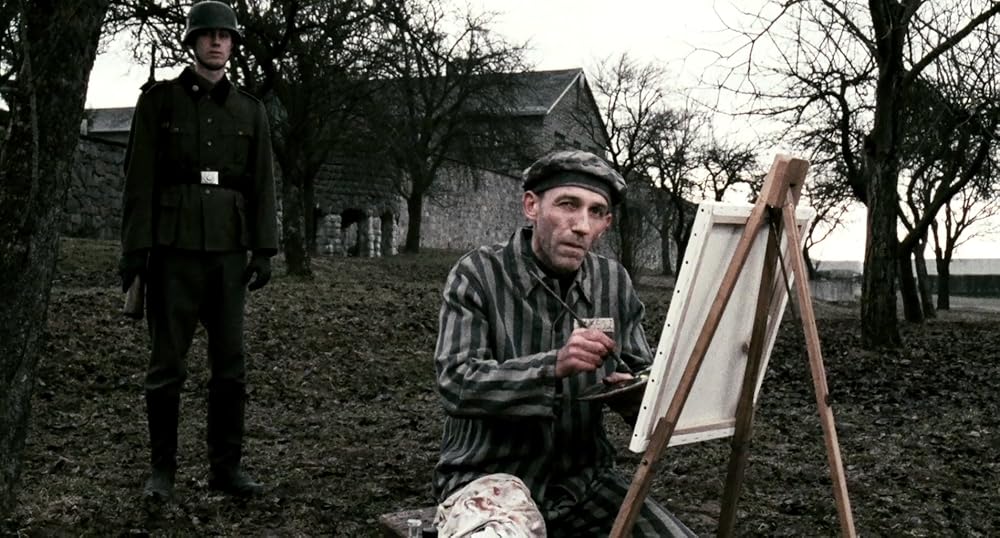
(Karl Markovics, August Diehl, Devid Striesow. Directed by Stefan Ruzowitzky.)
A review in the Age (an Australian newspaper) observes:
This tautly directed, cool-headed, soul-shuddering drama ranks as the most unnerving, disturbing, true-life account yet of endurance under Nazi oppression.
And the film’s unsettling power has little to do with indulging the now standard portrayals of brutality and privation. Instead, it pushes us deep into the fog of moral compromise with its lean, tortured tale about Jewish prisoners who agree to collaborate with their Nazi persecutors. …
To a large degree, we’ve been conditioned to expect certain things from Holocaust movies, and our responses — typically a mixture of outrage and sorrow — have been similarly honed into a kind of emotional rote.
There is, perversely, a measure of reassurance in seeing Nazis cast as unconditionally powerful villains and Jews as unconditionally powerless victims. It’s horrific, but at least the line between good and evil, between right and wrong, is not in doubt.
The Counterfeiters is entirely uninterested in providing any such emotional comfort zone. Its focus is on how blurry the line can get when one’s survival is at stake. …
(Jeon Do-yeon, Song Kang-ho, Jo Young-jin, Song Mi-rim, Seon Jeong-yeop. Directed by Lee Chang-dong.)
How can I possibly forgive? I might want to, but I can’t. He says God has already forgiven him. … If he’s been absolved, how can I forgive him again? How dare God absolve him before I’ve forgiven him myself? I am in so much pain … and yet he says he has found peace. How could God do that to me?
Here’s a video analysis of Secret Sunshine, with spoilers:
Stream Secret Sunshine on the Criterion Channel (leaving after September 2025) or YouTube (free with ads). If you don’t subscribe to the Criterion Channel, try a free trial.
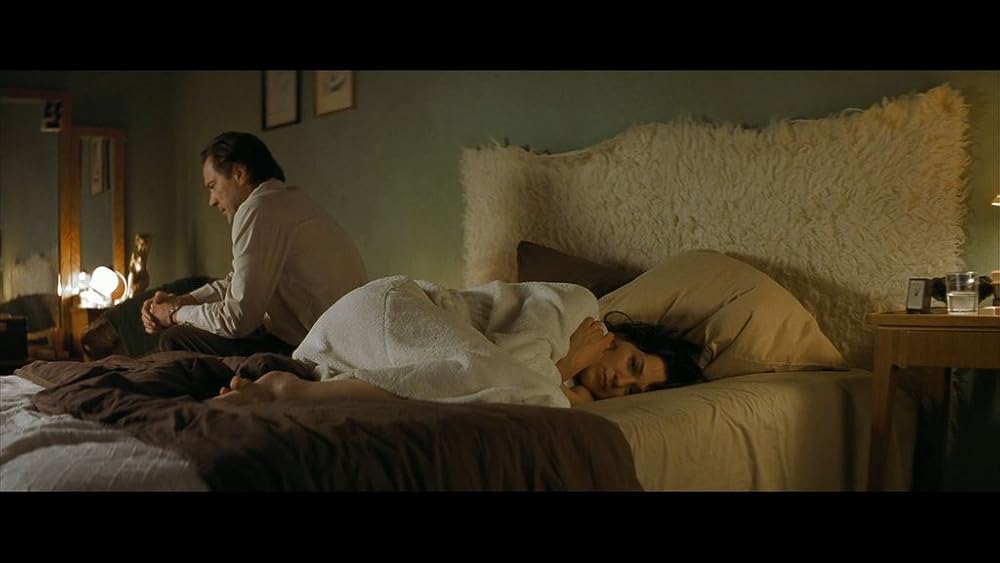
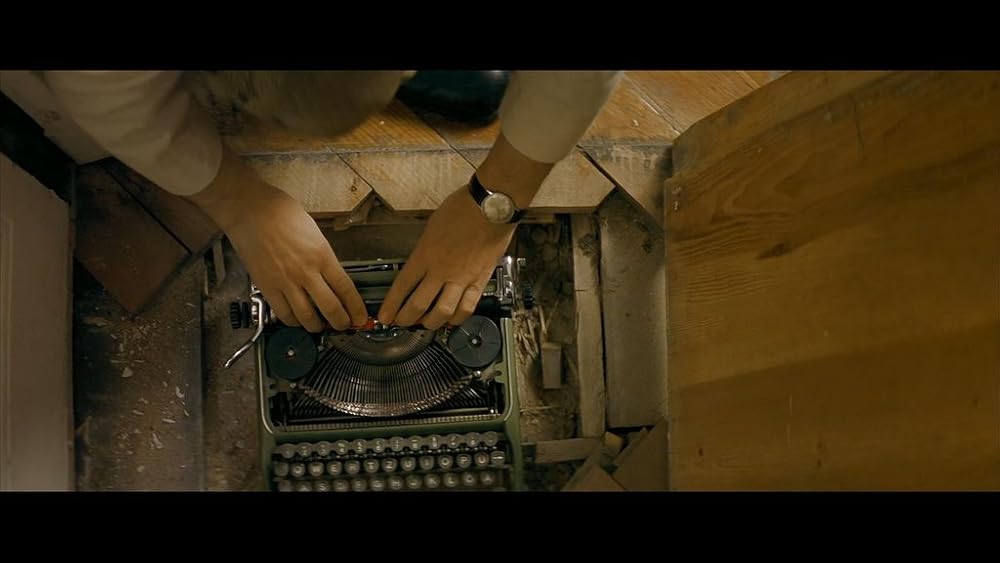
Posing a stark, difficult question — how does a good man act in circumstances that seem to rule out the very possibility of decent behavior? — [The Lives of Others] illuminates not only a shadowy period in recent German history, but also the moral no man’s land where base impulses and high principles converge. …
The suspense comes not only from the structure and pacing of the scenes, but also, more deeply, from the sense that even in an oppressive society, individuals are burdened with free will. You never know, from one moment to the next, what course any of the characters will choose. …
(Jonathan Rhys Meyers, Scarlett Johansson, Emily Mortimer. Directed by Woody Allen.)
Woody Allen has made a movie almost every year for more than 50 years. When asked to name his favorites of his own movies, he doesn’t list Annie Hall (my favorite movie of 1977) or Manhattan (my favorite of 1979). But I agree with him that Match Point is one of his best. It’s the kind of movie Hitchcock might have made if he were still alive.
The man who said “I’d rather be lucky than good” saw deeply into life.
(Michael Showalter, Michelle Williams, Elizabeth Banks, Justin Theroux, Peter Dinklage, Paul Rudd, Michael Ian Black, David Wain. Directed by Showalter.)
If you don’t mind me asking, what’s the dictionary for?
You won’t believe this, but it’s actually what I’m reading at the moment. …
I am also reading the dictionary! … What letter are you up to?
Right now I’m working my way through G. … I particularly liked the word “gromwell.”
The success of Napoleon Dynamite was famously hard to replicate. “The Napoleon Dynamite Problem” became used to refer to the difficulty of making an algorithm predict what else you’d like if you like Napoleon Dynamite. Apparently the movie was as odd as its characters.
My favorite of those characters is Napoleon Dynamite’s (Jon Heder’s) older brother, Kip (Aaron Ruell), who’s introduced to us when he’s sitting at home typing on a computer while in a romantic reverie, and tells Napoleon: “Don’t be jealous that I’ve been chatting online with babes all day.” Later, Kip says “I guess you could say things have been getting pretty serious” between him and one of those “babes,” though he’s “a little TO’ed because she hasn’t even sent me a full body shot yet.” I thought I could see where that subplot was heading, but the movie truly stunned me.
Napoleon Dynamite is the reason I don’t stop watching a movie when the closing credits start rolling. Keep watching past the very end of the credits, or you’ll be missing out on a wonderful moment.
I always feel like a freak, because I’m never able to move on like this 🫰🏻 — you know? People just have an affair, or even entire relationships, they break up, and they forget. They move on like they would have changed brand of cereals! I feel I was never able to forget anyone I’ve been with. … I never fully recover. That’s why I’m very careful with getting involved. … I will miss of the person the most mundane things. Like, I’m obsessed with little things. … When I was a little girl, my mom told me that I was always late to school. One day she followed me to see why. I was looking at chestnuts falling from the trees, rolling on the sidewalk, or ants crossing the road, the way a leaf casts a shadow on a tree trunk. … I think it’s the same with people. … You can never replace anyone, because everyone is made of such beautiful, specific details.
(Documentary. Directed by Joe Berlinger, Bruce Sinofsky.)
The biggest metal band ever, Metallica, battles their demons.
James Hetfield, the lead singer and rhythm guitarist, shares what he’s learned through recovering from alcoholism:
I don’t want to lose any of the stuff I have. I know it could all go away at one time. … All the drinking and all the other junk that I was stuck in — it was so predictable. So boring! I’m out there looking for excitement, and … the results were the same, man. I wake up the next day somewhere in some bed, I don’t know who this person is next to me, and I’m drunk, completely hung over, and have a show to do. … And life now is pretty exciting. You don’t know what’s going to happen when you’re kind of clear, and here, and in the now, in the moment.
You can stream Metallica: Some Kind of Monster on Netflix.
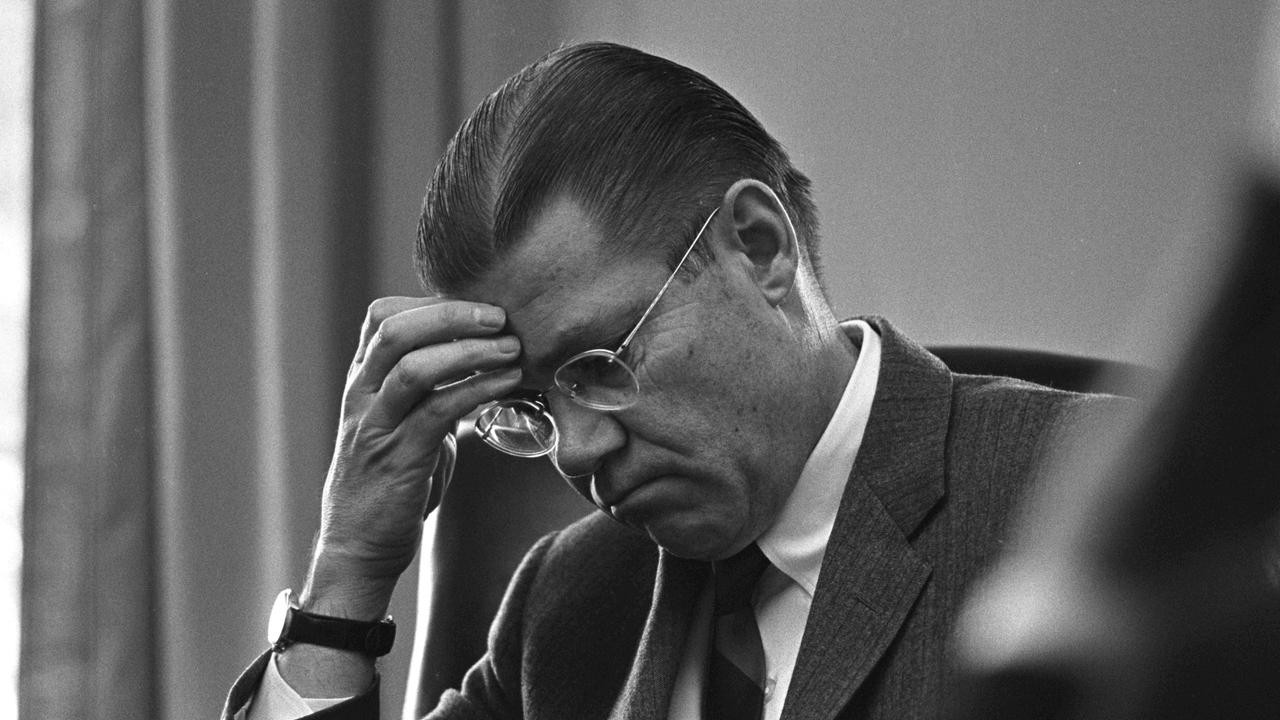
It’s not often you get to see a former Secretary of Defense sum up the theory behind a disastrous war he led, then stare directly into the camera and admit: “We were wrong.” This extraordinary documentary by Errol Morris is mainly about the Vietnam War, but it goes back to World War II. Here’s Secretary Robert S. McNamara on the Cuban missile crisis:
At the end, we lucked out! It was luck that prevented nuclear war. … Rational individuals — Kennedy was rational, Khrushchev was rational, Castro was rational — rational individuals came that close to total destruction of their societies.
Stream The Fog of War on Tubi (free with ads) or these sites.
(Jack Nicholson, Kathy Bates, Hope Davis, Dermot Mulroney, June Squibb. Directed by Alexander Payne.)
Once I am dead and everyone who knew me dies too, it will be as though I never existed. … I know we’re all pretty small in the big scheme of things, and I suppose the most you can hope for is to make some kind of difference. But what kind of difference have I made? What in the world is better because of me?
When Jack Nicholson won the Golden Globe for best actor in a drama, he said in his acceptance speech: “Well, I don’t know whether to be happy or ashamed, because I thought we made a comedy! … Dermot Mulroney, his haircut alone shoulda let you know it was a comedy!”
A documentary about spelling? Doesn’t that sound boring? Well how about this: it’s really a movie about America.
Corollary.
Corollary. May I have a definition please?
A proposition that follows upon one just demonstrated, and that requires no additional proof. …
Um, does it have to do with, like, a Corolla?
What’s a Corolla?
Uh, I don’t know, like the car?
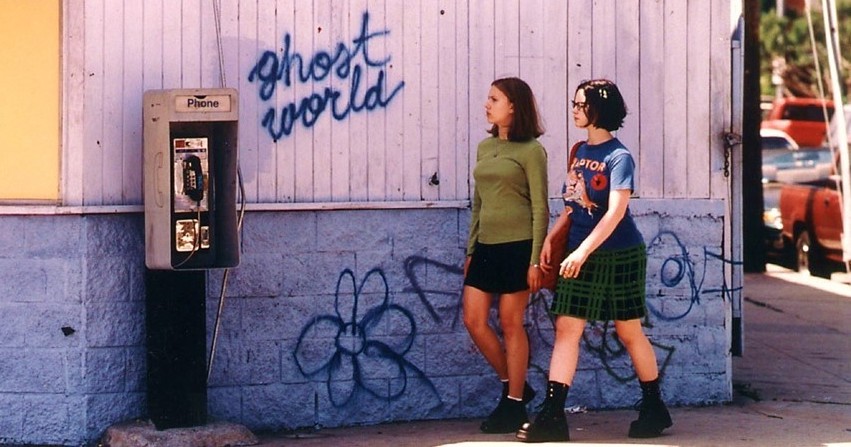
Ghost World is based on a comic book, and much of the movie is brightly colored and cartoonish on the surface. Yet by the time it’s over, I end up caring about these characters on a level I’ve rarely experienced with seemingly more realistic movies. My biggest complaint about this movie is that there isn’t a sequel — and it leaves you just aching for one!
To say that Ghost World is my favorite movie of the 21st century would be an understatement. For me, nothing else comes close. Ebert also felt strongly about it:
I wanted to hug this movie. It takes such a risky journey and never steps wrong. It creates specific, original, believable, lovable characters, and meanders with them through their inconsolable days, never losing its sense of humor.
Wikipedia says Ghost World had “minimal” “commercial success” at first, but has turned into “a cult film.” How has this off-beat indie movie, by a director whose previous movies were all documentaries, endured for 20 years? One thing is: Ghost World feels as relevant as ever because of the way it ties into “cancel culture.” And the movie repeatedly passes the “Bechdel test,” with several scenes where various different women talk to each other about stuff other than men.
What was it about that character? “Basically she had every opinion that I had at the time!” laughs Birch. “At that phase of my life I was just reaching adulthood and not ready for it and not feeling like I ever would be, and so a lot of her lines and the outlook on life were things I really felt, but at that time, I didn’t feel Thora Birch could go around expressing.”
But Terry Zwigoff (the director) and Daniel Clowes (the cartoonist, who wrote the screenplay with Zwigoff) wanted Birch to play Enid’s friend Rebecca, a supporting role which ended up going to an obscure actress named Scarlett Johansson:
“They didn’t really see me as an Enid,” says Birch. “But I loved the part so much that I was like, ‘I’m gonna go to lunch with these guys, I’m gonna cut my hair, I’m gonna dye it, and put on these fake glasses and show ’em.’ And it worked.” …
There must have been something seductive about negotiating the world as Enid? “Yeah, it’s her lack of filter,” says Birch. … “She calls out something that she thinks is lame. She says what she feels. And there is something liberating and freeing about that but it also can cause a lot of damage.” …
The 2021 article brings up the covid-19 pandemic:
Ghost World may have a special resonance right now. It is, after all, a film about loneliness. … [Birch] says the movie’s jaundiced outlook will always attract like-minded souls. “Introspection is really gripping a lot of people. So I think that comes into play for somebody watching Ghost World now — we’re all kind of forced to be closed off from others. But also: discontentment is not going out of fashion, you know?”
Ghost World is hard to categorize. Is it a “romantic comedy”? That might be literally true, but that trite label feels inadequate to describe a movie that doesn’t fall back on predictable plot formulas or cookie-cutter characters.
A movie that starts out as a quirky comedy about jaded teens drifting through a soulless, hyper-commercialized world pivots to a moodier, more atmospheric tone in the middle. After Enid buys an old blues record from Steve Buscemi’s character, Seymour, at his weekly garage sale, we watch her at home entering a contemplative, possibly trance-like state as she listens to one song on the record over and over (“Devil Got My Woman” by Skip James, singing and playing acoustic guitar with no accompaniment). The movie has briefly stopped being a comedy, and this scene will make it easier for us to accept even more dramatic tonal shifts later on.
When Enid goes back to the garage sale, she raves about the song she had on repeat and eagerly asks Seymour: “Do you have any other records like that?”
Seymour, who’s usually meek and self-effacing, has a rare moment of confidence when he responds knowingly: “There are no other records like that.”
Well … there are no other movies like Ghost World.
(Guy Pearce, Carrie-Anne Moss, Joe Pantoliano, Stephen Tobolowsky. Directed by Christopher Nolan.)
If you want a movie that doesn’t underestimate your intelligence, watch Memento. The anti-hero (Guy Pearce) craves revenge while struggling with short-term memory loss. The scenes in color are in reverse chronological order (e.g. the first one you see happened last in time). Those scenes are interspersed with black and white scenes that are in normal chronological order relative to themselves, but chronologically prior to all of the color scenes. The visual contrast of color and B&W corresponds to a mix of genres and moods: the color scenes are in the mode of a psychological thriller, while the B&W scenes feel more loose and contemplative.
When I saw Memento for the first time, I had a strange feeling afterwards — not necessarily positive or negative, but as if watching any other movie would be almost absurd.
I have to believe that my actions still have meaning, even if I can’t remember them. … We all need mirrors to remind ourselves who we are.