(Woody Allen, Diane Keaton, Mariel Hemingway, Michael Murphy, Meryl Streep. Directed by Allen.)
This is exactly the kind of movie I love: a dramedy that explores a few characters in a way that’s believable and relatable, and has no need for typical movie gimmicks like violence or magic. When I watch Manhattan, I feel like all the fakeness of other movies is being stripped away, and what we’re left with is more exciting: relationships, conversations, concerts, museums, restaurants, or just walking down the street — the pure stuff of everyday life, in “a city that exists in black and white, and pulsates to the great tunes of George Gershwin.”
You are so self-righteous. … We’re just people, you know? You think you’re God!
I gotta model myself after someone.
Capturing the Magic Hour, the narrow sliver of time just around sunrise and sunset, is a difficult task for filmmakers. They’re limited in how much time they can film before the light becomes too bright or too dark. When they succeed, as Malick and the cinematographer Nestor Almendros do here, the effect is impressionistic: Characters appear softer in the faded light; scenes are warmer from the reddish tone sun’s rays; objects or extras can be backlit against the purple and pastel skies to enhance the depths of the colorful natural landscape.
Ebert’s insight helped me watch this movie in the right frame of mind:
“Days of Heaven” has been praised for its painterly images and evocative score, but criticized for its muted emotions: Although passions erupt … all the feelings are somehow held at arm’s length. This observation is true enough, if you think only about the actions of the adults in the story. But … this is the story of a teenage girl, told by her, and its subject is the way that hope and cheer have been beaten down in her heart. We do not feel the full passion of the adults because it is not her passion: It is seen at a distance, as a phenomenon, like the weather. …
Linda Manz, in her movie debut, not only played the teenage girl but also spent many hours improvising all of her narration, which was then edited down for the movie. The male lead, Richard Gere, said of Manz’s work on this movie (quoted in a Criterion essay published after she died at age 58 in 2020): “Anyone with that kind of brilliance, you just give them space. … She was a kind of unique, extraordinary, eccentric wild animal. And some jewels came out of her mouth.” She wasn’t credited as a writer.
(Donald Sutherland, Brooke Adams, Leonard Nimoy, Jeff Goldblum, Veronica Cartwright. Directed by Philip Kaufman.)
Conformity takes over, and people’s natural emotional reactions become deadened.
Of course, this is just a sci-fi horror movie. That could never happen in real life … right?
Here’s a filmmaker reacting to seeing the movie for the first time:
He makes some good points about the movie:
(1) The characters are believably smart yet flawed. This isn’t the kind of movie that depends on people being either idiots or super-geniuses.
(2) It’s an extraordinary horror movie where what scares us isn’t just some monster or attacker; the true horror can be seen only by watching how people relate to each other.
Stream Invasion of the Body Snatchers on these sites.
(Melanie Mayron, Anita Skinner, Christopher Guest, Eli Wallach, Bob Balaban. Directed by Claudia Weill.)
Creative types deal with loneliness and self-doubt in this indie time capsule of ’70s New York City.
For a long time it was hard to see Girlfriends, but Criterion just put out a restored version on blu-ray (and DVD). Kubrick loved the movie: “I thought it was a wonderful film. It seemed to make no compromise to the inner truth of the story, the theme, and everything else.”
This quote is from a scene where the Jewish female protagonist, a struggling photographer (Melanie Mayron), reacts to the reactions to her work:
I must have seen about 50 people in the last three days. “Yes your work is good, very good, but we’re just not needing anything right now. … You have a very good eye, young lady!” Young lady, young lady, young lady! You know, I’m going to be old by the time I get to do what I want, and by then I will have forgotten what it was.
(Woody Allen, Diane Keaton, Carol Kane, Tony Roberts, Shelley Duvall, Janet Margolin, Christopher Walken, Paul Simon. Directed by Allen.)
There’s so much to say about Annie Hall’s innovative techniques (subtitles of the two main characters’ thoughts when they’re getting to know each other, split screens to show how they live in different worlds when they’re not around each other, animation) … playing with chronology, the fourth wall, and other conventions … wittily insightful dialogue … understated but affecting performances by Diane Keaton and Woody Allen … and one great line by a young Jeff Goldblum. For now, I’ll just say that I “lurve” this movie — I “luff” it — it’s “too wonderful for words.”
I thought of that old joke. You know, this guy goes to his psychiatrist and says, “Doc, my brother’s crazy — he thinks he’s a chicken!” And the doctor says, “Well, why don’t you turn him in?” The guy says, “I would, but I need the eggs.” Well, I guess that’s … how I feel about relationships. You know, they’re totally irrational and crazy and absurd. But I guess we keep going through it because most of us … need the eggs.
(Sophia Loren, Marcello Mastroianni. Directed by Ettore Scola.)
Rome, 1938. Everyone’s heading out to see Hitler’s state visit with Mussolini, but two neighbors in the same housing complex stay behind. One is a woman (Sophia Loren) stuck in a loveless marriage, who’s planning to have a seventh child in order to get benefits the Italian government is offering as a way to grow the population. So a whole person will come into existence to serve the state’s goals. The other is a man (Marcello Mastroianni) who’s ostracized for being gay and “subversive,” meaning opposed to fascism.
For this brief moment on this day, these two people, both quietly oppressed, will try to find something meaningful in each other … while we hear propaganda music from the state visit blaring in the background. The bold choice to use this incessant, insipid music, instead of a more conventional dramatic soundtrack, is a constant reminder that their society has turned into an echo chamber, and enforced conformity is in the air.
The action on screen in A Special Day is minimal. What you feel by the end might not be.
Taxi Driver is the fevered story of an outsider in New York [Robert De Niro] — a man who can’t find any point of entry into human society. … Scorsese, with his sultry moodiness and his appetite for the pulp sensationalism of forties movies, is just the director to define an American underground man’s resentment. … [H]is asthmatic bedridden childhood in a Sicilian-American home in Little Italy propelled him toward a fix on the violently exciting movies he saw. … Scorsese got something out of his asthma: he knows how to make us experience the terror of suffocation.
(Jack Nicholson, Louise Fletcher, Will Sampson, Brad Dourif, William Redfield, Sydney Lassick, Christopher Lloyd, Danny DeVito, Scatman Crothers. Directed by Miloš Forman.)
This movie about a rebellious new patient at a mental institution (Jack Nicholson) is one of only 3 movies that’s ever swept all top 5 Oscars: Best Picture, Director, Actor, Actress, and Screenplay.
What are you doing here? … You guys do nothing but complain about how you can’t stand it in this place here, and then you haven’t got the guts just to walk out?! I mean what do you think you are … crazy or something? Well you’re not! You’re not! You’re no crazier than the average asshole out walking around on the streets, and that’s it! …
Those are very challenging observations you made, Randle.
Louise Fletcher, who plays the draconian Nurse Ratched, did a great job of accepting her Oscar for Best Actress:
She thanked Nicholson and the other actors, who “made being in a mental institution … like being in a mental institution.” At the end she signed a message to her parents, who were both deaf.
Stream One Flew over the Cuckoo’s Nest on these sites.
(Al Pacino, John Cazale, Charles Durning, Chris Sarandon, Penelope Allen, Carol Kane. Directed by Sidney Lumet.)
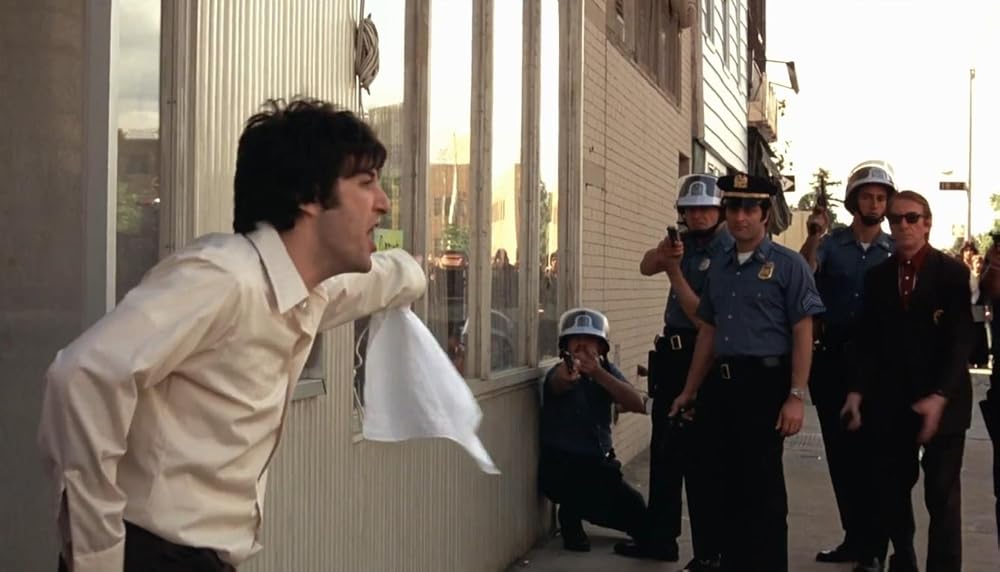
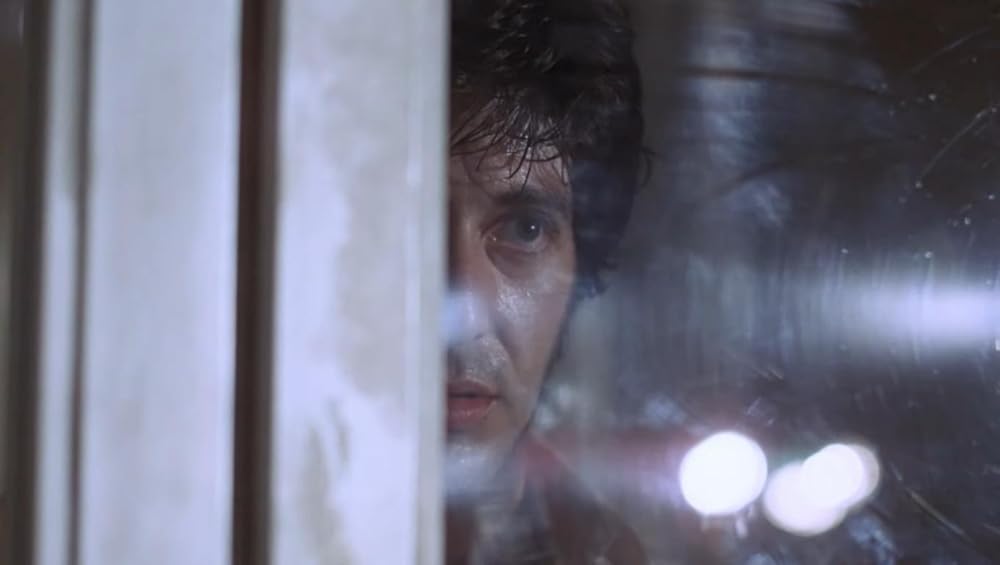
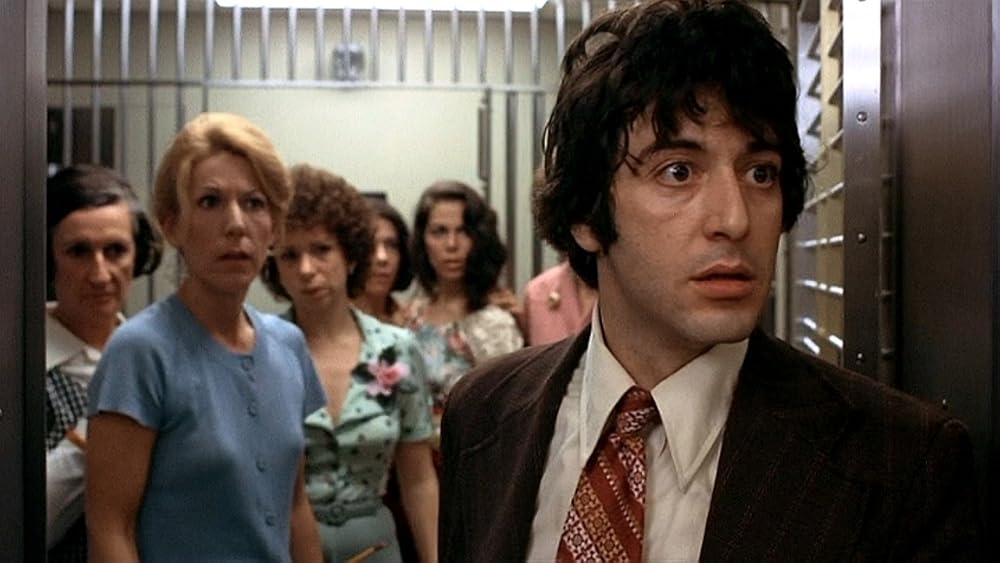
Al Pacino has an acting tour de force as the ringleader of a bank robbery in Brooklyn. Everything goes wrong, starting when one of his two accomplices gets cold feet and walks out at the beginning. The two remaining robbers keep getting bogged down while stuck in the bank for hours, and eventually they’re surrounded by police, media, loved ones, and a raucous crowd. As the masses of people grow, the lines between “good guys” and “bad guys” can seem to be blurred or crossed. (Example: When Pacino frees the bank’s security guard — a black man having an asthma attack — police immediately descend on him and handcuff him.)
Ebert observed how different characters react to the media frenzy:
Pacino has said the most memorable moment in the movie involves the delivery boy (Lionel Pina) who brings pizza to the robbers and their hostages. He’s been watching the drama unfold on live TV, and when he’s applauded by the crowd, he does a little skip and jump and says, “I’m a star!” Television turns the moment into what, at that time, was a fairly new event for live broadcasting. Sonny expands in the TV lights, strutting back and forth in front of the bank and unwisely exposing himself to rooftops lined with snipers.
More from Ebert:
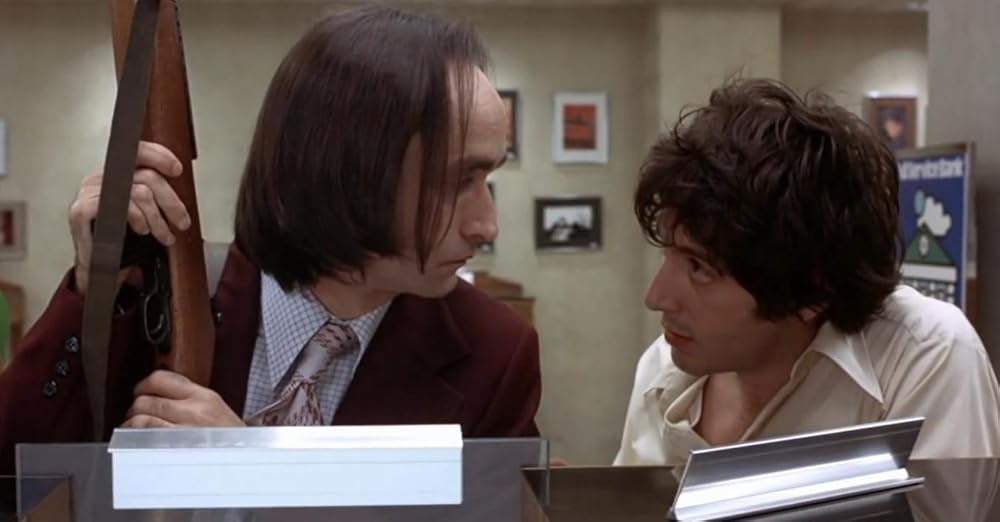
His remaining partner Sal (John Cazale), on the other hand, shrinks within himself. He can’t believe he’s a bank robber. … He’s offended that on TV, which has the facts a little confused, he’s described as a homosexual. He can’t believe he’s expected to get on a jet with the others and fly to safety. He’s never flown before. Asked to name a foreign country they can fly to, he says “Wyoming.” The line was improvised on the spot by Cazale.
I was surprised how much I laughed at this thriller based on a true story. Ebert captures the tone:
Although the movie contains tragedy and the potential for greater tragedy, it is also tremendously funny. But Frank Pierson’s Oscar-winning screenplay never pauses for a laugh; the laughter grows organically out of people and situations. You can believe that even with hostages taken and firearms being waved around, such elements of human comedy would nevertheless arise.
While some of the hostages are smoking inside the bank, their coworker Sylvia (Penelope Allen) asks for a cigarette even though she doesn’t smoke. Cazale’s character, who doesn’t smoke either, questions why Sylvia would start smoking now when it causes cancer, and Sylvia retorts that if she does get cancer it’ll be half his fault. In real life, Cazale was a heavy smoker who was diagnosed with lung cancer in 1977, and he died in 1978 at age 42. John Cazale had an extraordinary distinction: All 5 movies he ever appeared in were nominated for the Oscar for Best Picture.
You can stream Dog Day Afternoon on HBO Max or Tubi (it left but will likely come back) or these sites.
(Gene Hackman, Cindy Williams, Frederic Forrest, Harrison Ford, John Cazale, Teri Garr. Directed by Francis Ford Coppola.)
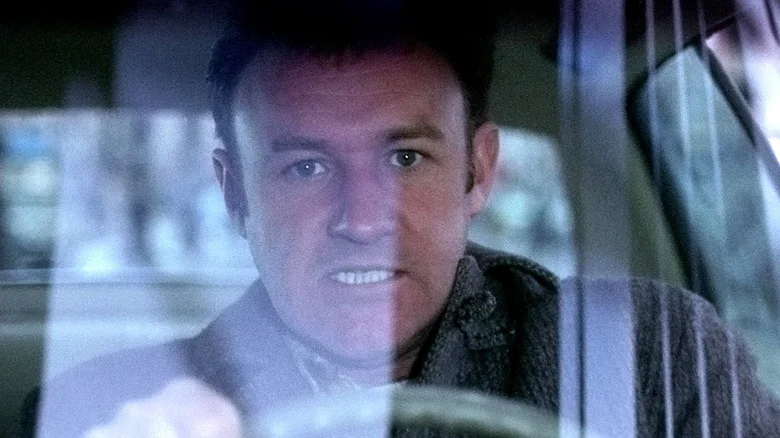
The main character (Gene Hackman) spends his days listening to strangers from a distance, while closing himself off from the people closest to him.
Oh God! … Every time I see one of those old [homeless] guys, I always think the same thing. I always think that he was once somebody’s baby boy. …
That’s no ordinary conversation. … Listen to the way she says, “Oh God!”
The last scene stands out for its haunting juxtaposition of music and visuals.
The above video on “what makes this movie great” has several good points about Chinatown, including:
• “Keeping you from the truth is media. … Throughout the movie, you’ll see different media being between the point of view of the detective [Jack Nicholson] and then the reality beyond the media. You get newspapers for example … views through binoculars … cameras … then finally the detective sort of gets rid of all those. …”
• “[The] idea of having one side scarred or maimed, and one side pristine or handsome, comes up a lot in this movie. Part of the world is nice. … Part of the world is scarred, bloodied, maimed, awful. And the detective is going from one side of that to the other. … On the outside we’re all nice, bright, and shiny, like Mrs. Mulwray [Faye Dunaway]. … She’s beautiful, she’s rich, it’s fancy at her house. … Once you start to look inside at the interiors, you’ll see it’s broken and screwed up … horrific. And so that idea of one side nice, one side maimed, comes up throughout the movie as a metaphor for exteriors and interiors.”
I’m adding this movie to this post on October 29, 2024, the day Teri Garr died after a long battle with multiple sclerosis (1944 - 2024). She’s wonderful in several movies on this blog, including this one, The Conversation (at the top of this post), and After Hours (1985).
You’ll forget about this miscarriage, and we’ll have another child, and we’ll go on, you and I. …
It wasn’t a miscarriage. It was an abortion. … I wouldn’t bring another one of your sons into this world.
(Pierre Blaise, Aurore Clément. Directed by Louis Malle.)
Pauline Kael wrote about why it worked so well to cast Pierre Blaise, who had never acted before, in the leading role of a Nazi youth who falls in love with a Jewish girl in 1944:
Introducing himself to a delicate, fine-boned parisienne, [he] does not give his name as Lucien Lacombe; he gives the bureaucratic designation — Lacombe, Lucien. He presents himself name inverted because he is trying to be formal and proper, as he’s been trained to be at school and at work, sweeping floors at his local, small-town hospital, in southwest France. When he meets the girl, France Horn [Aurore Clément], … his new job is hunting down and torturing people for the Gestapo. He likes it a whole lot better than the hospital. The title Lacombe, Lucien refers to the case of a boy of seventeen who doesn’t achieve a fully human identity, a boy who has an empty space where feelings beyond the purely instinctive are expected to be. …
We look at Blaise’s face in a different way from the way we watch a trained actor. We look into it rather than react to an actor’s performance. The enigma of a Lucien … is the enigma of an open face and a dark, closed mind. Professional actors have the wrong kind of face for this sort of unborn consciousness, and they tend to project thoughts and feelings from the blank area. Blaise doesn’t, and we trust our readings of his silent face almost as if we were watching a documentary. …
Without even mentioning the subject of innocence and guilt, Lacombe, Lucien, in its calm, leisurely, dispassionate way, addresses it on a deeper level than any other movie I know.
Tragically, the world didn’t get to see much more of Pierre Blaise. The year after this movie came out, he was driving home from a party when he died in an accident at age 20.
(Richard Dreyfuss, Ron Howard, Cindy Williams, Charles Martin Smith, Candy Clark, Harrison Ford. Directed by George Lucas.)
George Lucas, the director/writer, has said he knew that each plotline in this movie about adolescents in 1962 was a thin “thread,” but they came together to make a “rope.” More memorable than any one of the stories is the bittersweet atmosphere evoked by the ’50s and early ’60s music which suffuses the whole movie.
In this scene, Richard Dreyfuss is riding with his friends when he becomes entranced by a fleeting encounter with a young woman in another car (Suzanne Somers):
Quick … cut over to G Street! I just saw a vision … a goddess! Come on, you’ve got to catch up to her! … This was the most perfect, dazzling creature I’ve ever seen! … She spoke to me right through the window! I think she said, “I love you.” That means nothing to you people? You have no romance, no soul? … Someone roaming the streets wants me! Will you turn the corner?
Ebert saw the “elusive blonde in the white Thunderbird” as a symbol of “innocence in the process of being lost.” Ebert concluded:
“American Graffiti” is not only a great movie but a brilliant work of historical fiction; no sociological treatise could duplicate the movie’s success in remembering exactly how it was to be alive at that cultural instant.
(Gene Hackman, Al Pacino, Eileen Brennan, Dorothy Tristan, Ann Wedgeworth, Richard Lynch, Penelope Allen. Directed by Jerry Schatzberg.)
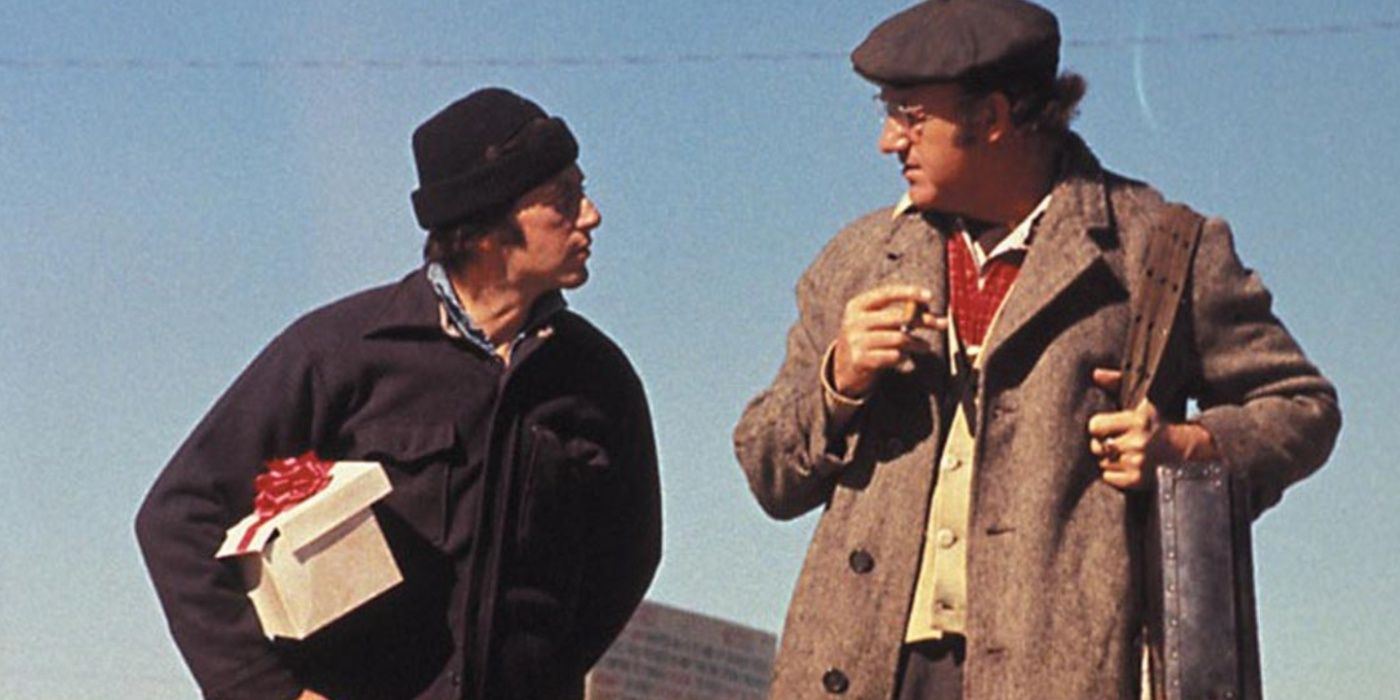
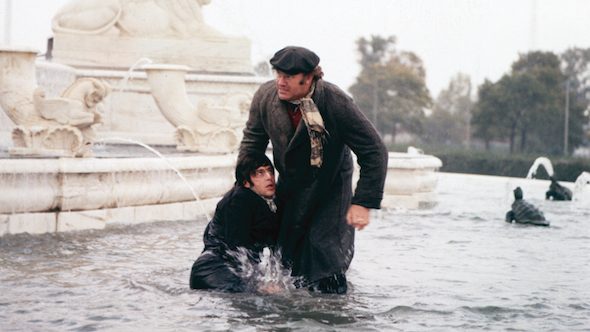
Scarecrow is the only movie with the late Gene Hackman and Al Pacino together, and their chemistry is something special. Pacino later said he found Hackman difficult to work with. But Hackman, in this David Letterman interview, called it “probably my favorite film to work on.” (See the video below. At the beginning, Lettermen calls Scarecrow “one of my all-time favorite films.”)
Hackman and Pacino play drifters who team up when they meet on a California road. Each man has a goal he wants to achieve with the other’s help … but the goals don’t seem to make sense. Hackman wants them to start a car wash business in Pittsburgh — with virtually no explanation why they should travel across the country to do that, or why Hackman needs Pacino, a simpleton with a childlike sweetness, as his business partner.
Hackman would seem to be the brains of the operation, which is unfortunate since he’s dumb and volatile. He’s fresh out of prison and prone to getting in fights.
Meanwhile, Pacino wants to reconnect with the mother of his 5-year-old and give the kid a gift: a lamp. Why a lamp? Pacino has never met his child and doesn’t even know the kid’s gender, so he picked a gift he could give to either a son or a daughter.
Scarecrow is a rare movie that was shot entirely in order, which likely added to its authentic, rambling quality. People come away from the movie feeling like it doesn’t have much of a plot — yet the two men go through major ups and downs, covering a great distance both physically and emotionally (I won’t spoil how). But the plot feels improvised, as if they came up with each scene on the spot right before filming.
Another reason the movie feels deceptively plotless: the characters’ supposed goals aren’t the real point. They’re an excuse for us to get to know two people who aren’t equipped to deal with the modern world — a world of laws and jobs and relationships they don’t know how to navigate. (Example: Hackman tells Pacino to create a distraction to allow Hackman to shoplift, but Pacino’s attempt at this is so bizarre that it distracts Hackman so much he can’t go through with the shoplifting.) They’re struggling to find some human connection … and realizing that the best they can do might be to make someone laugh.
Woody Allen plays a health-food store owner in New York City in 1973 who’s frozen after a routine medical procedure goes wrong, until he wakes up 200 years later in a dystopian society where America has turned into a police state, and rebels are trying to use him to infiltrate the government. He tries one weird idea after another to get by in the soullessly automated future, from impersonating an android butler (see the video below), to stealing engineered food that’s bigger than himself, to kidnapping Diane Keaton.
She plays a bad poet with a comfortable lifestyle that’s typical for the year 2173, when people expect to get all their pleasure from technology such as an “orgasmatron,” a machine they step into for instant sex with none of the complications. (When we and Woody Allen first meet Diane Keaton, she’s having some friends over and casually remarks to one of them as they’re leaving: “We should’ve had sex, but there weren’t enough people.”)
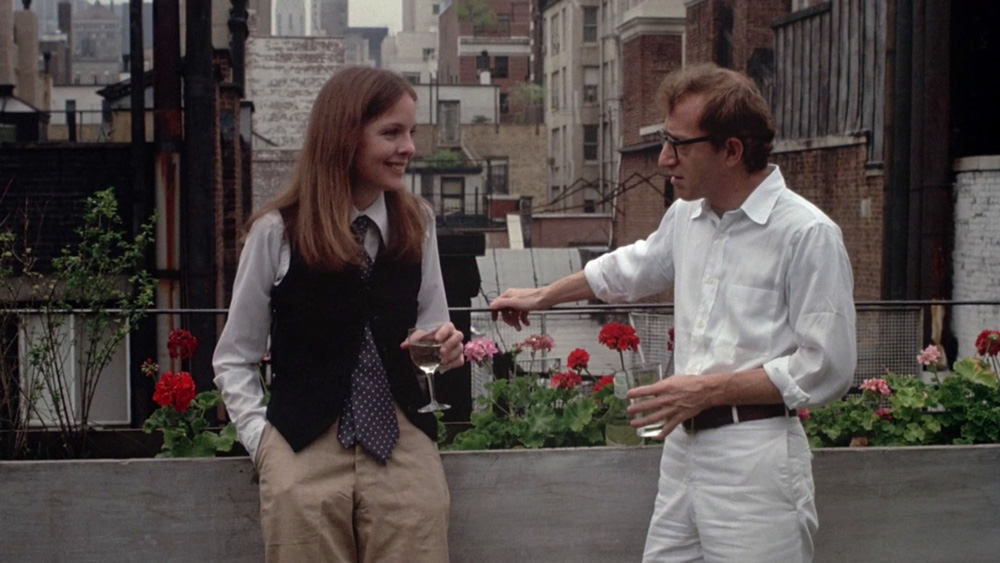
Diane Keaton and Woody Allen’s constant squabbling is the heart of Sleeper and points the way to how they’d be paired up again, more seriously and enjoyably, in Annie Hall (my favorite movie of 1977) and Manhattan (my favorite of 1979).
(Marlon Brando, Al Pacino, Robert Duvall, James Caan, Diane Keaton, John Cazale, Abe Vigoda, Richard Conte, Sterling Hayden, Talia Shire. Directed by Francis Ford Coppola.)
Pauline Kael called The Godfather a “startlingly vivid view of a Mafia dynasty, in which organized crime becomes an obscene nightmare image of American free enterprise.”
“The Godfather” is told entirely within a closed world. That’s why we sympathize with characters who are essentially evil. The story by Mario Puzo and Francis Ford Coppola is a brilliant conjuring act, inviting us to consider the Mafia entirely on its own terms. Don Vito Corleone (Marlon Brando) emerges as a sympathetic and even admirable character; during the entire film, this lifelong professional criminal does nothing of which we can really disapprove.
During the movie we see not a single actual civilian victim of organized crime. … The story views the Mafia from the inside. That is its secret, its charm, its spell. … The real world is replaced by an authoritarian patriarchy where power and justice flow from the Godfather, and the only villains are traitors. There is one commandment, spoken by Michael (Al Pacino): “Don’t ever take sides against the family.”
My father’s no different than any other powerful man — any man who’s responsible for other people, like a Senator or a president.
You know how naive you sound? Senators and presidents don’t have men killed!
Who’s being naive, Kay?
UPDATE (July 2022):James Caan has died at age 82. He was in The Godfather and The Godfather Part II, and he was nominated for the Oscar for Best Supporting Actor for the first movie.
(Max von Sydow, Liv Ullmann, Eddie Axberg. Directed by Jan Troell.)
The New Land is the sequel to The Emigrants (one of my choices for 1971), and together they form a 6-and-a-half-hour epic about Swedish farmers who start a new life in Minnesota in the mid-19th century. The Criterion essay says:
Subtly, Troell allows us to see that marriage itself is a kind of emigration: a matter of settling into another life, making the necessary accommodations, and gradually — over years, over decades — finding that you think of this person who is not you, or this place that is not the land of your birth, as your home. This idea is particularly important in The New Land, in which terrible things happen to several of the Swedish pilgrims; America gives and it takes away, no blessing unmixed. …
Like that era’s other great saga of the immigrant experience, The Godfather (1972) and The Godfather: Part II (1974), this epic is part of how we understand America now — Troell’s movies telling the story of those who settled not in the bustling, violent, darkly glamorous cities but in the vast middle of America, in the dailiness and hard slog of country life. For the taciturn rural toilers no less than for the fast-talking urban wise guys, it was tough to get here and, often, tougher yet to remain and thrive: the New World’s bounty came at a cost.
I don’t know anywhere to stream The Emigrants or The New Land, but you can buy the Criterion blu-ray or DVD set of the two movies through the Barnes & Noble 50% off sale on all Criterion discs every November and July. (Amazon has also been reducing some prices in response.)
(Malcolm McDowell, Patrick Magee, Adrienne Corri. Directed by Stanley Kubrick.)
After a gang leader (Malcolm McDowell) is convicted of atrocious crimes, the government offers an experimental alternative to his prison sentence: aversion therapy, with the aim of conditioning him to have a disgust response to violent or prurient thoughts.
In one memorable scene, he’s aghast that the Beethoven symphony being played during the treatment could also be conditioning him to find his favorite music intolerable, so he begs the government scientists to stop the treatment:
You needn’t take it any further, Sir! You’ve proved to me that all this ultra-violence and killing is wrong … terribly wrong! I’ve learned my lesson, Sir! …
No, no … you really must leave it to us, and be cheerful about it! In less than a fortnight now, you’ll be a free man.
(Cybill Shepherd, Timothy Bottoms, Jeff Bridges, Cloris Leachman, Ben Johnson, Ellen Burstyn. Directed by Peter Bogdanovich.)
This movie set in a small town in northern Texas in 1951-52 has been called an “aching portrait of a dying West,” and a “hushed depiction of crumbling American values.” Pauline Kael said (New Yorker link — clicking on that might limit your articles if you don’t subscribe): “Concerned with adolescent experience seen in terms of flatlands anomie — loneliness, ignorance about sex, confusion about one’s aims in life — the movie has a basic decency of feeling, with people relating to one another, sometimes on very simple levels, and becoming miserable when they can’t relate.”
All of that makes The Last Picture Show sound well-done, but relentlessly depressing. Those descriptions leave out the movie’s low-key sense of humor, which I could see inspiring The Office’s focus on cringe-inducingly awkward moments.
Bein’ married always so miserable?
No, not really. About 80% of the time.
Stream The Last Picture Show on the Criterion Channel (with bonus features including commentary by Bogdanovich and some of the cast) and Amazon Prime (it left Prime but will likely come back), or these sites.
The Emigrants is an epic drama, but there’s a moment of levity when the Swedish characters arrive in New York City and try to make sense of the rich and poor people they’re seeing:
You said people aren’t divided into gentry and commoners here in America!
Um, I only said they weren’t divided into different classes. … There are two kinds of people in America: those who’ve been here so long that they’ve gotten rich, and those so new here they haven’t had time to get rich.
I don’t know anywhere to stream The Emigrants, but you can buy the Criterion blu-ray or DVD set of this movie and its sequel through the Barnes & Noble 50% off sale on all Criterion movies every July and November. Amazon sometimes lowers prices at the same times.
(Woody Allen, Louise Lasser, Howard Cosell, Sylvester Stallone. Directed by Allen.)
You’re not supposed to take Bananas seriously — it’s utterly silly. And yet … I did get something meaningful out of how this movie shows a relationship between a woman who’s passionate about political causes, and a man who cares about those causes only if it’ll help him get into bed with her. (They’re played by Woody Allen and his real-life ex-wife at the time, Louise Lasser.)
Bananas morphs from romantic comedy to political satire/farce when the man’s bumbling attempt at activism in New York City somehow causes him to get thrown into the middle of a dictatorship vs. rebels conflict in a fictional country. The New York Times 1971 review summed up Woody Allen’s character:
Here is no little man surviving with a wan smile and a shrug, but a runty, wise-mouthed guy whose initial impulses toward cowardice seem really heroic in the crazy order of the way things are.
The bits at the beginning and end of the movie, with Howard Cosell playing a newscaster reporting live on the scene, were prescient about the idea of media intruding into the most personal times of some people’s lives.








.jpg)