Posts

Showing posts with the label all 1950s

my favorite movie of 1959:

(1) Some Like It Hot

(2) The 400 Blows

(3) Anatomy of a Murder

(4) Imitation of Life

favorite of 1959:

Some Like It Hot

(Marilyn Monroe, Tony Curtis, Jack Lemmon, Joe E. Brown, George Raft. Directed by Billy Wilder.)

Some Like It Hot, which has been called “the greatest comedy of all time,” is so spectacularly joyous that it’s hard to believe it was directed and co-written by the same person who directed and co-wrote the grim, dark Double Indemnity (my favorite of 1944).

Here are “13 sizzling facts about Some Like It Hot.” The intro to that list sums up why it’s such a “weird, subversive picture”:

two hard-luck jazz musicians (Curtis and Lemmon) who witness the St. Valentine’s Day Massacre go into hiding as women in an all-female orchestra, and must navigate love and attraction — one lusts after the band’s sultry singer, played by Monroe, while the other is pursued by a wily old millionaire — all while dodging the mob. The film cuts against the cultural grain so sharply that it’s a miracle it got made at all. …

When I was a kid, Joe, I used to have a dream. I was locked up overnight in a pastry shop, and there was goodies all around! There was jelly rolls, and mocha eclairs, and sponge cake, and Boston creme pie, and cherry tarts —

Listen to me. No butter, no pastry. We’re on a diet.

“Nobody’s perfect,” but Some Like It Hot comes close.

Stream Some Like It Hot on Amazon Prime, Tubi (free with ads), the Roku Channel (also free with ads), or these sites.


2nd favorite of 1959:

The 400 Blows

(Jean-Pierre Léaud, Claire Maurier, Albert Rémy, Guy Decomble, Jeanne Moreau (cameo). Directed by François Truffaut.)

I was underwhelmed when I first saw The 400 Blows on an old DVD. I found it enjoyable enough as a slice-of-life movie about a troubled pre-teen kid, but I wasn’t sure why it’s considered one of the greatest movies of all time — ranked #50 in the most recent Sight and Sound poll.

When I recently watched the restored version on the Criterion Channel, I finally appreciated the genius I missed before. The black and white doesn’t just look beautiful but also adds to our understanding of the main character, Antoine Doinel (Jean-Pierre Léaud). We need to take in the sights of Paris along with him while he roams around the city so we can feel the contrast with the indoor scenes where he’s confined in one rectangle after another: the classroom, his home, a police station…

Director François Truffaut had a minimal budget to make this debut (one of the most striking directorial debuts ever), but his frugality turned out to be a gift: he used cheap hand-held cameras which freely followed Antoine wherever he went outdoors, in contrast with indoor scenes where the camera would stay still — a subtle cue that Antoine found his real freedom outside of institutions.

The movie starts with a seemingly childish moment that’s actually too serious for the adult in the room to understand. Young boys in the all-male classroom are mischievously passing around a pin-up photo, and when it’s passed to Antoine he spends a few extra seconds drawing some detail on the picture. That gets the attention of the authoritarian teacher, who puts him in a corner. This pattern repeats over and over: Antoine commits some small transgression that could be seen as understandable awkwardness from a boy in the process of discovering who he is, but all the adults see is that he’s breaking the rules. Instead of looking for the root of the problem, they respond with more and more restrictions to maintain order within their little indoor rectangles.

Truffaut had the child actor Léaud approach his role in a straightforwardly stoic manner — as Truffaut said, “not to depict adolescence from the usual viewpoint of sentimental nostalgia but ... to show it as the painful experience it is.”

Truffaut is the rare filmmaker who respects us enough to show us the truth without trying to be reassuring. He cowrote the movie based on his own childhood. Truffaut and the kid in the movie, Antoine, would both sneak into movie theaters as an escape from their regimented world.

Another parallel to Truffaut’s real life: Antoine runs away from home after getting in trouble for making up a disturbing excuse for his truancy: falsely saying his mom had died. Significantly, this is after Antoine discovers her having an affair and is quietly forced to choose between being honest with his dad or keeping the peace at home. Later we learn that Antoine’s “dad” is really his stepdad, and he never knew his biological father. In real life, Truffaut also ran away from home after getting in trouble for making up an excuse for his truancy, but he told a different lie: that his dad had been arrested by Germans (during World War II). As this Criterion essay points out: “The recent revelation that Truffaut’s biological father—whom he never knew—was a Jewish dentist renders this excuse especially poignant.”

In the video below, Dr. Josh Matthews suggests that we could think of The 400 Blows as a “wronged man” movie. I’d rather think of it as a “wrong system” movie: the system isn’t right for Antoine, and no one in the system will admit it. The accusations against him might be factually true, but the adults react to each offense in a vacuum instead of seeing the bigger picture. The movie shows one grown-up after another saying the problem is Antoine has been given too much freedom. While watching it, I wished I could step into the world of this movie and tell the adults: “Yes he isn’t perfect, but you’re not perfect either. The difference is that he’s vulnerable, while you’re protected from the consequences of your behavior, and you don’t see the irony: that’s the opposite of the harsh consequences you think he needs.”

Stream The 400 Blows on the Criterion Channel (with bonus features including commentary and video of auditions for the movie), HBO Max, or these sites.


3rd favorite of 1959:

Anatomy of a Murder

(James Stewart, Lee Remick, George C. Scott, Ben Gazzara. Directed by Otto Preminger.)

As a lawyer, I’ve had to learn that people aren’t just good or just bad. People are many things.

In this legal drama with a darkly comical edge, a Michigan lawyer named Paul Biegler (Jimmy Stewart) has just lost reelection as District Attorney. He seems happy to be semi-retired and spending his time relaxing, fishing, and playing piano, until he’s asked by Laura Manion (Lee Remick) to defend her husband, a young Army veteran, Frederick “Manny” Manion (Ben Gazzara), against a murder charge. Manny admits he killed Barney Quill, the owner of a local inn and tavern, after hearing that Barney raped Laura.

Anatomy of a Murder has been praised for realistically showing almost every phase of a criminal trial from start to finish. But beyond the legal process, there’s a fascinating human dimension to this ensemble movie. A smooth and savvy big-city prosecutor (George C. Scott, in an Oscar-nominated role) persistently tries to destroy the Manions’ reputations, insinuating that the wife is a tramp and the husband is a wife-beater. Jimmy Stewart (also Oscar-nominated) as Biegler responds with a folksy, small-town appeal … or at least he’ll try to keep that up without getting overemotional at the prosecution’s efforts to destroy the married couple.

Laura Manion (Lee Remick) on the witness stand, reacting to a question from the prosecutor (George C. Scott)

Anatomy of a Murder was ground-breaking in the ’50s, back when audiences weren’t used to hearing movie characters say words like “rape” and “climax” and “sperm” and “panties” (which a review at the time said “are bound to shock many of you”). The movie doesn’t always hold up well today; there are moments when I cringe at how casually issues of rape and domestic violence are treated. The first time I saw it, I found that off-putting and didn’t add it to this blog. When I rewatched it, I was able to see deeper into this movie and appreciate that it still has something to offer us even though it would never be made like that today. A Guardian review from 2005 commented:

is Laura an innocent victim, or a harlot? And who gave her those bruises? Is she the one really on trial here? This movie takes a brisk, mannishly worldly, and very much a pre-feminist attitude to this ambiguity. To modern audiences that may jar, and critics have complained about the movie’s two-dimensional approach to women. But to me Remick’s damaged, dysfunctional presence is the really subversive thing about the picture.

Anatomy of a Murder shows that a trial isn’t just about applying the law to a set of facts and coming up with the right answer, the way an AI machine might do; a trial can peel off the outer layers of people’s lives and expose their dark or mysterious sides to an awkward mix of people close to them and strangers. The most haunting image in this movie isn’t evidence or anything in the courtroom, but Laura Manion’s face after Biegler takes her away from a bar where she had been acting flirty, and gives her a set of new rules to limit her socializing and sex appeal while her husband’s trial is underway. At that point, the camera zooms in on her and we see the utter loneliness of this young woman who was acting carefree just a minute ago, now that she grasps what it means for everyone’s eyes to be on her. Whether or not the Manions get the verdict they want, they might never be the same again.

The Manions face each other in court (Ben Gazzara and Lee Remick)

I’m a fan of both Jimmy Stewart and jazz, so I especially enjoy the cameo by Duke Ellington, playing piano next to Stewart in a bar. A seemingly unnecessary moment, but it has significance. Ellington co-wrote and performed the movie’s soundtrack, which is all jazz — none of the majestic orchestral music you might expect in a movie like this. In that musical choice is an unspoken comment on the law itself — that it’s not as elegant or orderly as we might hope, but that the law, like jazz, is rough and unpredictable and deeply human.

Stream Anatomy of a Murder on Amazon Prime (it left but might come back at that link) or these sites.


4th favorite of 1959:

Imitation of Life

(Lana Turner, Juanita Moore, Sandra Dee, Susan Kohner, John Gavin. Directed by Douglas Sirk.)
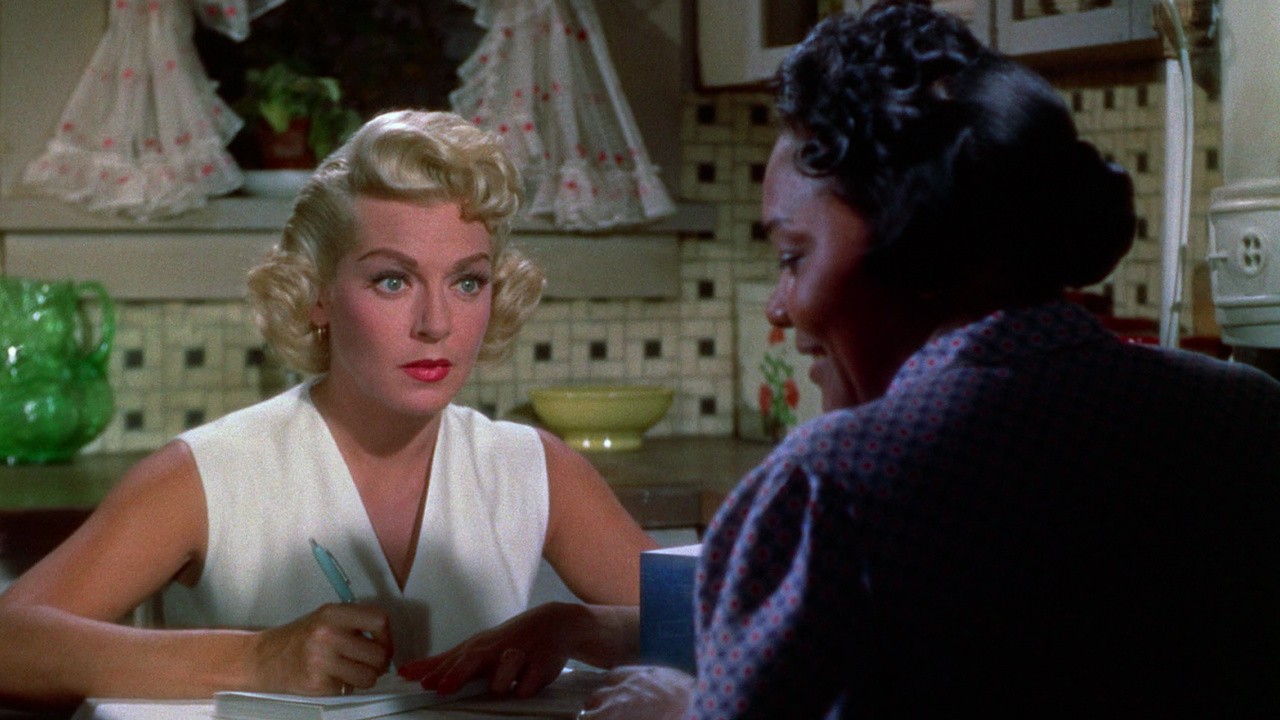
It seems to be obligatory, when reviewing a movie directed by Douglas Sirk, to describe it as “glossy,” “melodramatic,” and reminiscent of a “soap opera.” But Ebert had this insight about another Sirk movie, which also applies to Imitation of Life:

To appreciate a film like “Written on the Wind” probably takes more sophistication than to understand one of Ingmar Bergman’s masterpieces, because Bergman’s themes are visible and underlined, while with Sirk the style conceals the message. … [H]e wants you to notice the artifice, to see that he’s not using realism but an exaggerated Hollywood studio style.

In Imitation of Life, Sirk applies his colorful gloss to the surface of a dark and disturbing critique of America as a place where racism and sexism threaten to break down good people’s lives.

Juanita Moore and Susan Kohner were nominated for Best Supporting Actress Oscars for playing a mother and daughter. The daughter looks white and doesn’t want people to find out that her mother is black. This video shows the daughter when her white boyfriend realizes the truth (please use discretion in playing this video, as it includes a racial epithet):

Stream Imitation of Life on Amazon Prime (it left but might come back at that link) or these sites.

Click here for the full list of my favorite movie(s) of each year from 1920 to 2020.

my favorite movies of 1958:

(1) Vertigo

(2) The Music Room

(3) Elevator to the Gallows

favorite of 1958:

Vertigo

(James Stewart, Kim Novak, Barbara Bel Geddes. Directed by Alfred Hitchcock.)

Some say this is the greatest movie ever made. Others dispute that it’s even the best Hitchcock movie. But it’s at least his most exquisitely beautiful movie.

Kim Novak talked about her performance in Vertigo as a meta-commentary on being an actress (in an interview by Roger Ebert):

In a way, that was how Hollywood treated its women in those days. I could really identify with Judy, being pushed and pulled this way and that, being told what dresses to wear, how to walk, how to behave. I think there was a little edge in my performance that I was trying to suggest that I would not allow myself to be pushed beyond a certain point. … I know that Hitchcock gave me a lot of freedom in creating the character, but he was very exact in telling me exactly what to do — how to move, where to stand. I think you can see a little of me resisting that in some of the shots, kind of insisting on my own identity.

Ebert expanded on that:

[Vertigo] is about how Hitchcock used, feared and tried to control women. He is represented by Scottie (James Stewart), a man with physical and mental weaknesses (back problems, fear of heights), who falls obsessively in love with the image of a woman. … When he cannot have her, he finds another woman and tries to mold her, dress her, train her, change her makeup and her hair, until she looks like the woman he desires. He cares nothing about the clay he is shaping. …

Ebert added that Vertigo’s “emotional threads come together in the greatest single shot in all of Hitchcock,” which “may be the one time in his entire career” when he “completely revealed himself, in all of his passion and sadness.”

The leading man and woman (Stewart and Novak) give phenomenal performances, both embodying fascinatingly complex and subtle characters. At the same time, Hitchcock movies are great not only because of dynamite starring roles, but also because of supporting actors like Barbara Bel Geddes who play more ordinary people. Her interactions with her old flame, Jimmy Stewart’s character, add levity to keep the movie from getting too ruminative. Sometimes Vertigo becomes so ethereal and mystical you feel like it could almost drift away into the air, but Bel Geddes brings it back down to earth. I particularly love the small moment of grace in her last line of the movie, in a hospital where they’re treating Stewart’s trauma with “musical therapy” (having him rest while listening to peaceful classical music), when she says with meaningful but unappreciated concern: “You want to know something, Doctor? I don’t think Mozart’s going to help at all.”

Speaking of being unappreciated, it took a while for audiences to come around to Vertigo. It didn’t win any Oscars, and wasn’t even nominated for any except in two technical categories (Best Art Direction and Best Sound). Wikipedia quotes some of the “mixed” reviews at the time, e.g. the New Yorker grumbled that Hitchcock had “never before indulged in such farfetched nonsense.” Hitchcock believed the initial response was tepid because people were put off by the age gap between Stewart and Novak, who are supposed to have a romance when he’s twice her age — and yes, the movie might be more enjoyable if you overlook that awkward aspect.

But I’ve been watching and loving this movie since I was very young, and it never gets old. All the different dimensions of Vertigo — the story … the acting … the words … the visuals … and the music, oh, the music! — come together to make one of the very best movies I’ve ever seen.

Stream Vertigo on Amazon Prime or these sites.


2nd favorite of 1958:

The Music Room

[Bengali: Jalsaghar]     জলসাঘর

(Chhabi Biswas, Padma Devi, Pinaki Sen Gupta, Roshan Kumari. Directed by Satyajit Ray.)

What Sunset Boulevard (1950) is to Hollywood, The Music Room is to real estate. A landlord clings to his past greatness while languishing in his decaying mansion. As his fortune dwindles, some of his few remaining comforts — and some of the highlights of the movie — are the private concerts he hosts at his estate. This is a must-see for anyone with a taste for Indian classical music.

Pauline Kael called The Music Room an “extraordinary study of pride carried to extremity” and a “great, flawed, maddening film — hard to take but probably impossible to forget.” The movie is sometimes choppily pieced together, so even if you usually avoid spoilers you might want to read Ebert’s review to get a sense of the overall plot arc before watching it.

Here’s a video analysis of The Music Room — “What Makes This Movie Great?” (from Learning About Movies, a YouTube channel by Dr. Josh Matthews)

Stream The Music Room on the Criterion Channel (with bonus features). If you don’t subscribe, try a free trial.


3rd favorite of 1958:

Elevator to the Gallows

[French: Ascenseur pour l’échafaud]

(Jeanne Moreau, Maurice Ronet, Georges Poujouly, Yori Bertin. Directed by Louis Malle.)

In an essay on “watching women walk,” Imogen Sara Smith says:

The film that fully established [Jeanne Moreau] as a star is Louis Malle’s Elevator to the Gallows (1958), and its centerpiece follows her character, Florence, as she wanders Paris all night alone, searching for her lover, Julien (Maurice Ronet). (They were supposed to meet after he carried out their plan to murder her husband, but he got trapped in an elevator when the power was shut down.) The sequence is famous for Miles Davis’s score — an exhalation of peerless cool that blows through the film like a night breeze — and for the cinematography by Henri Decaë, who broke ground by using only available light from streetlamps and store-windows. But Moreau’s presence is so expressive that the music seems to emanate from her (Davis, in fact, improvised as he watched the footage), and the grainy shadows and hazy smears of light seem to be filtered through her numb, shattered exhaustion. As she moves toward the camera, at times she passes in and out of focus, suggesting the drift of her mind between sharp pangs of anxiety and trancelike despair. …

At first her steps are brisk and purposeful, but as she fails again and again to find news of Julien, she starts to move more slowly, more aimlessly, muttering to herself so that passersby eye her suspiciously. She reaches out to touch parked cars as she passes, lightly caressing one in which she saw a man she fleetingly mistook for her lover. Her eyes begin to look slightly mad, gazing inward. … She is alone in her anguished absorption, drifting haunted and unseeing through a world that has become senseless. …
Here’s Miles Davis recording the soundtrack while watching the movie:

Stream Elevator to the Gallows on the Criterion Channel (with bonus features) or HBO Max.

Click here for the full list of my favorite movie(s) of each year from 1920 to 2020.

my favorite movies of 1957:

(1) Paths of Glory

(2) The Cranes Are Flying

(3) Witness for the Prosecution

(4) Wild Strawberries

(5) White Nights

favorite of 1957:

Paths of Glory

(Kirk Douglas, Ralph Meeker, Wayne Morris, Adolphe Menjou, George Macready, Timothy Carey, Joe Turkel. Directed by Stanley Kubrick.)

Ebert describes the leading man of this anti-war movie:

Kirk Douglas, a star whose intelligence and ambition sometimes pulled him away from the comfortable path mapped by the system, contains most of the emotion of his character. When he is angry, we know it, but he stays just within the edge of going too far. He remains an officer. He does his duty. He finds a way to define his duty more deeply than his superiors would have wished, but in a way they cannot condemn.

One of my favorite scenes in the movie might seem unexciting on its face, but ends up being both witty and chilling (see the video below). Kirk Douglas’s superior is arguing for going through with planned executions:

There’s the question of the troops’ morale — don’t forget that!

The troops’ morale?

Certainly! These executions will be a perfect tonic for the entire division! There are few things more fundamentally encouraging and stimulating than seeing someone else die!

I never thought of that, Sir.

That line by Kirk Douglas, “I never thought of that,” has a wonderfully dry double meaning. On the surface he seems to be praising his superior’s intelligence, but what he really means is: I can’t believe you’d be so inhuman.

The only woman whose voice is heard in this movie is a German prisoner of war who doesn’t speak the French troops’ language, but she deeply moves them by singing. Ebert observes: “If the singing of ‘La Marseillaise’ in a bar in ‘Casablanca’ was a call to patriotism, this scene is an argument against it. It creates a moment of quiet and tenderness in the daily horror these soldiers occupy.” The actress is credited as Susanne Christiane, but she soon changed her name to Christian Kubrick when she married the director, Stanley Kubrick. They met while making this movie and stayed married until his death in 1999.

Stream Paths of Glory on Amazon Prime (it left but will likely come back), YouTube (free with ads), Tubi (free with ads), or these sites.


2nd favorite of 1957:

The Cranes Are Flying

[Russian: Letyat zhuravli]    Летят журавли

(Tatiana Samoilova, Alexei Batalov, Alexander Shvorin, Vasily Merkuryev. Directed by Mikhail Kalatozov.)

Another director (Jeremiah Zagar) says this about The Cranes Are Flying:

incredible black-and-white cinematography. There’s one scene in the film that I literally show to everyone I ever make a movie with. It’s shot through a fence, when Tatiana Samoilova is running, and the camera … speeds up with the pace of her running. It has this effect where it makes your heart race in a way that’s insane. The other thing about that movie is that it’s an epic told from a woman’s point of view, which you rarely see.

For more analysis, see this essay (which tells the whole plot).


Stream The Cranes Are Flying on the Criterion Channel (with extra features) or Max. If you don’t subscribe to the Criterion Channel, try a free trial.


3rd favorite of 1957:

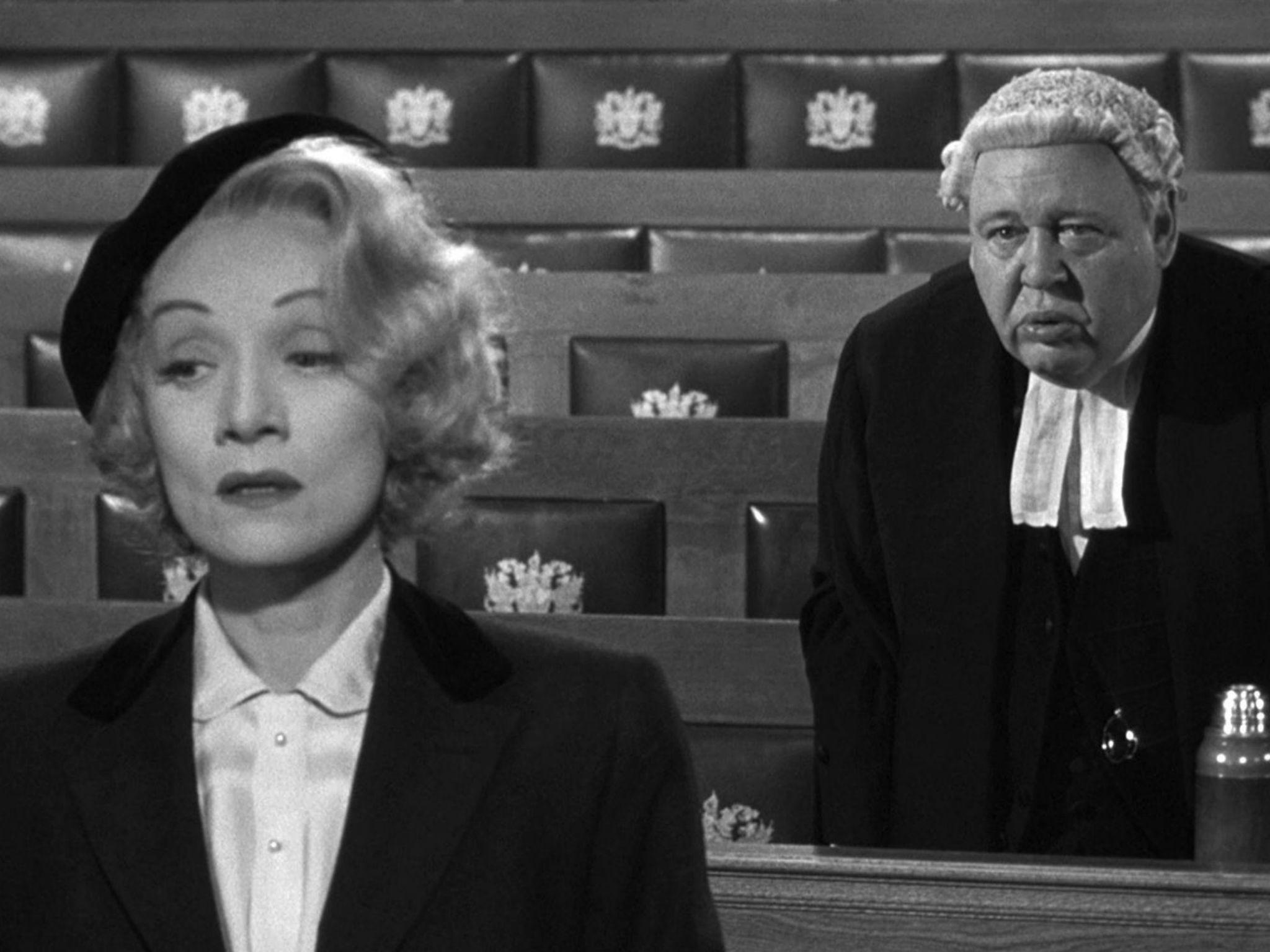
Witness for the Prosecution

(Charles Laughton, Marlene Dietrich, Tyrone Power, Elsa Lanchester. Directed by Billy Wilder.)

Hitchcock said: “Many times, people have told me how much they enjoyed Witness for the Prosecution. They thought it was my film instead of Billy Wilder’s.”

Wilder mischievously mixes light comedy and dark drama in this murder mystery based on an Agatha Christie play, which has one stunning twist after another.

Touching isn’t it, the way he counts on his wife?

Yes, like a drowning man clutching at a razor blade.

Stream Witness for the Prosecution on Amazon PrimeYouTube (free with ads), Tubi (free with ads), Kanopy, or these sites.


4th favorite of 1957:

Wild Strawberries

[Swedish: Smultronstället]

(Victor Sjöström, Bibi Andersson, Gunnar Björnstrand, Ingrid Thulin, Naima Wifstrand, Max von Sydow. Directed by Ingmar Bergman.)

A 78-year-old microbiologist looks back on his life while he goes on a road trip, has disconcerting dreams, and steps into his past in fantasy sequences that would influence Woody Allen (see Annie Hall, my favorite movie of 1977).

Writer/director Ingmar Bergman chose Victor Sjöström, who directed silent movies decades earlier and became a mentor to Bergman, to play the old man. Bergman admitted it’s no coincidence that he and the character, Professor Isak Borg, shared the same initials. Bergman was only in his 30s when he made Wild Strawberries, but he had gone through serious health problems that caused him to be hospitalized for months, and he was thinking about what it’s like to face death.

Stream Wild Strawberries on the Criterion Channel (with extras including commentary), Max, or Kanopy.


5th favorite of 1957:

White Nights

[Italian: Le Notti Bianche]

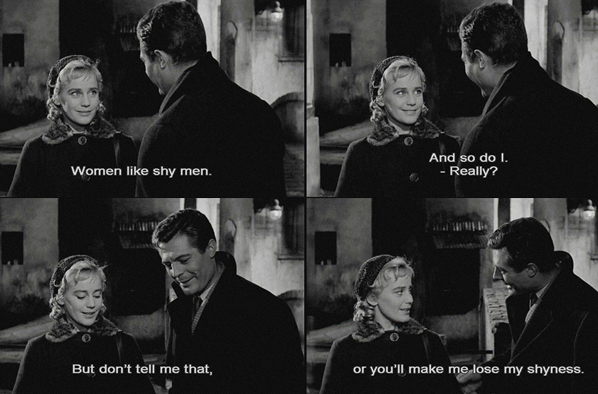
(Marcello Mastroianni, Maria Schell, Jean Marais, Clara Calamai. Directed by Luchino Visconti.)

Two lonely, sensitive people meet while wandering around a dark city filmed in beautiful black and white. Based on a short story by Dostoevsky, with a haunting minimalist score by Nino Rota.

Stream White Nights on the Criterion Channel, with bonus features.

Click here for the full list of my favorite movie(s) of each year from 1920 to 2020.

my favorite movies of 1956:

(1) The Wrong Man

(2) The Killing

(3) The Bitter Stems

favorite of 1956:

The Wrong Man

(Henry Fonda, Vera Miles. Directed by Alfred Hitchcock.)

A critic on Ebert’s website says this might be “the least fun” of Hitchcock’s Hollywood movies:

For “The Wrong Man,” Hitchcock took his task so … seriously that he denied himself his usual winking cameo, the appearance (usually early on) of Hitch in some dryly humorous posture interacting with the world he’s creating. The director does appear in the movie, addressing the audience directly in a prologue, but his mien is different than it would be in his droll introductions to the episodes of TV’s “Alfred Hitchcock Presents”; … in silhouette and long shot, he all but warns his audience that this is a “different” kind of story for him. The difference, we are meant to infer, is in the documentary value: the scenario is based on a true event, and Hitchcock tells it with great attention to realism and verisimilitude. …

More from that review:

The movie tells the story of Christopher Balestrero, nicknamed “Manny,” a member of the house band at New York’s swanky Stork Club in the early ’50s, who found himself on the receiving end of a very bad case of mistaken identity, enduring arrest and trial for a series of small-time robberies that he did not commit. Screen icon of integrity Henry Fonda plays Manny and Vera Miles is his wife Rose, who suffers a breakdown and serious attendant depression as a result of the ordeal. …

Stream The Wrong Man on these sites.


2nd favorite of 1956:

The Killing

(Sterling Hayden, Marie Windsor, Elisha Cook Jr., Vince Edwards, Coleen Gray, Timothy Carey, Joe Turkel. Directed by Stanley Kubrick.)

You have not yet learned that in this life you have to be like everyone else — the perfect mediocrity, no better, no worse. Individuality is a monster, and it must be strangled in its cradle to make our friends feel confident. … I’ve often thought that the gangster and the artist are the same in the eyes of the masses. They are admired and hero-worshipped, but there is … an underlying wish to see them destroyed at the peak of their glory.

Stream The Killing on Amazon PrimeYouTube (free with ads), Kanopy, or one of these sites.


3rd favorite of 1956:

The Bitter Stems

[Spanish: Los Tallos Amargos]

(Carlos Cores, Vassili Lambrinos, Gabriele Ferzetti. Directed by Fernando Ayala.)

Watch someone watching The Bitter Stems for the first time:

In this psychological noir from Argentina, a struggling journalist named Gasper (Carlos Cores) thinks he’s found salvation when he meets the charismatic Liudas (Vassili Lambrinos), who lures him into a get-rich-quick scheme where they run a scam journalism school.

If you know film noir, you know what to expect next: cold-blooded corruption, searing betrayal, deepening paranoia, impending downfall. But The Bitter Stems isn’t a noir-by-numbers. As the interestingly named Gasper starts suffocating under his guilt, plot twists tangle with fragmented dialogue, and the line between dreams and reality is blurred.

I recommend approaching The Bitter Stems not as just one more noir, but as a character study of a man who doesn’t realize how much his avoidance of other people holds him back from really living. Gasper pushes away those who offer love and support while he plunges into bitter isolation. What’s his real enemy: his con-artist partner, or himself?

Trains run through this story; trains can connect people but can also bring danger. Seeds contain a similar duality: growth, nourishment, renewal … yet burial, decay, bitterness.

Stream The Bitter Stems on these sites.

Click here for the full list of my favorite movie(s) of each year from 1920 to 2020.

my favorite movies of 1955:

(1) The Night of the Hunter

(2) Rififi

(3) All That Heaven Allows

(4) Smiles of a Summer Night

(5) The Big Combo

favorite of 1955:

The Night of the Hunter

(Robert Mitchum, Shelley Winters, Lillian Gish, Billy Chapin, Peter Graves. Directed by Charles Laughton.)

The Night of the Hunter was a flop that eventually became recognized as a masterwork. Why didn’t audiences like it at first? Maybe this offbeat blend of Southern Gothic, film noir, fairy tale, and psychological horror about a religious con artist was too far ahead of its time. Also, the beginning and ending are relatively weak, so the movie might not have made a great first or last impression on people seeing it in the theater. It helps to brush those parts aside and focus on the strengths of The Night of the Hunter, which are most of the movie.

Ebert said:

Charles Laughton’s The Night of the Hunter is one of the greatest of all American films, but has never received the attention it deserves because of its lack of the proper trappings. Many “great movies” are by great directors, but Laughton directed only this one film, which was a critical and commercial failure. … And many great movies are realistic, but The Night of the Hunter is an expressionistic oddity, telling its chilling story through visual fantasy. … Yet what a compelling, frightening and beautiful film it is! And how well it has survived its period. Many films from the mid-1950s, even the good ones, seem somewhat dated now, but by setting his story in an invented movie world outside conventional realism, Laughton gave it a timelessness.

The movie focuses on two children who need to protect themselves when grown-ups won’t. I love the moment when one of the adults finally appreciates the kids’ power and says this to one of them (with an unfortunately dated use of “man” to mean humanity — the movie is set in the Great Depression and has a lot of old-fashioned language):

John, you know, when you’re little, you have more endurance than God is ever to grant you again. Children are man at his strongest.

Stream The Night of the Hunter on YouTube (free with ads), Tubi (free with ads), Kanopy, or these sites.


2nd favorite of 1955:

Rififi

[French: Du Rififi Chez les Hommes]

(Jean Servais, Carl Möhner, Robert Manuel, Jules Dassin [as “Perlo Vita”], Magali Noël. Directed by Dassin.)

After the director Jules Dassin was blacklisted by Hollywood, he moved abroad and made this French movie, Rififi, which builds on the heist movie genre created by The Asphalt Jungle (one of my favorite movies of 1950). This Criterion essay elaborates:

John Huston had established the rules of the caper film with … The Asphalt Jungle; Dassin put greater emphasis on the process. The gang spends much time studiously casing the [jewelry store] and the apartment upstairs, then doing meticulous research on the store’s hypersensitive alarm system.

The actual burglary … is an unforgettable half-hour tour de force. Employing an umbrella and a fire extinguisher among its tools, the heist involves commando-raid timing and brain-surgery precision. [The thieves] exhibit the wordless teamwork of astronauts in deep space. The only thing to break the silence is the musique concrète of clinking tools, a humming drill, gently falling plaster, the quickly muffled alarm, and occasional footsteps in the street.

Ebert’s review adds atmosphere:

Dassin was a particular master of shooting on city locations. … In “Rififi,” Dassin finds everyday locales: Nightclubs, bistros, a construction site, investing them with a grey reality. Just before the heist begins, there is a scene all the more lovely because it is unnecessary, in which nightclub musicians warm up and gradually slide into collaboration. There’s a real sense of Montmartre in the 1950s.

Rififi was controversial — Wikipedia tells us:

The film was banned in some countries due to its heist scene, referred to by the Los Angeles Times reviewer as a “master class in breaking and entering as well as filmmaking.” The Mexican interior ministry banned the film because of a series of burglaries mimicking its heist scene. Rififi was banned in Finland in 1955 and released in severely cut form in 1959 with an additional tax because of its content. In answer to critics who saw the film as an educational process that taught people how to commit burglary, Dassin claimed the film showed how difficult it was to actually carry out a crime.

After we’ve gone through the possibly amoral experience of empathizing with the thieves and enjoying the half-hour heist, one thief’s wife brings a conscience to the movie when she lays this devastating point on him:

There are kids — millions of kids who’ve grown up poor like you. How did it happen — what difference was there between them and you, that you became a hood, a tough guy, and not them? Know what I think, Jo? They’re the tough guys, not you.

Rififi is often hard to find streaming, but you can check here. Aside from that, I recommend the Criterion blu-ray (or DVD). You might be able to get a better price with the Barnes & Noble 50% off sale on all Criterion movies, which usually happens throughout July and November. (Amazon often lowers its prices during those sales.)


3rd favorite of 1955:

All That Heaven Allows

(Jane Wyman, Rock Hudson, Agnes Moorehead. Directed by Douglas Sirk.)

A male arborist (Rock Hudson) and an older, more affluent widow (Jane Wyman) enter a relationship that draws scorn from their community. This movie isn’t perfect; some of the acting is wooden, including Hudson, who feels dated in his self-conscious attempt to project earthily masculine attractiveness. Wyman is the standout, with her subtle portrayal of the conflicted woman.

All That Heaven Allows was directed in a lushly expressionistic style by Douglas Sirk. (For more about his approach, see my post about Imitation of Life, one of my favorite movies of 1959.) The commentary on the Criterion blu-ray/DVD, which is also on the Criterion Channel, often notes how the Sirkian attention to visual details (color, clothing, etc.) beautifully underscores the story and characters.

There’s no question that All That Heaven Allows is a melodrama that was specifically marketed at women, but anyone should be able to appreciate this movie. I was struck by one scene which reminded me, oddly enough, of a moment in The Terminator (one of my favorite movies of 1984) where a young person in a dystopian future stares at a fire in a hollowed-out TV. In All That Heaven Allows, the woman is alone in her staid, upper-middle-class home with a new TV set that’s been pitched to her as an exciting way to improve her life in the 1950s, and the TV screen is reflecting her fireplace as a call-back to an earlier scene involving the couple, when the man’s fireplace burned in his more rustic home.

Earlier in the movie, Jane Wyman reads out loud from Henry David Thoreau’s Walden:

“The mass of men lead lives of quiet desperation. Why should we be in such desperate haste to succeed? If a man does not keep pace with his companions, perhaps it’s because he hears a different drummer. Let him step to the music he hears, however measured or far away.”

Stream All That Heaven Allows on the Criterion Channel and Amazon Prime (it left but will likely come back).


4th favorite of 1955:

Smiles of a Summer Night

[Swedish: Sommarnattens Leende]

(Gunnar Björnstrand, Eva Dahlbeck, Ulla Jacobsson, Björn Bjelfvenstam, Jarl Kulle, Margit Carlqvist, Harriet Andersson, Åke Fridell, Naima Wifstrand. Directed by Ingmar Bergman.)

Ingmar Bergman made Smiles of a Summer Night at the end of a suicidally depressive period in his life, and this movie became his big commercial breakthrough. It’s unusually comedic and light for Bergman, but it’s heavier and darker than most comedies.

A Criterion essay on this movie says: “Consider now what Bergman views as one of the greatest goods and one of the greatest evils. That perhaps supreme good is what he calls contact; the name of the fate worse than death is humiliation. … What happens when attempted contact fails: humiliation for one or both parties.” While watching Smiles of a Summer Night, notice when and how the various characters are humiliated.

You can stream Smiles of a Summer Night on the Criterion Channel (with bonus features). If you want to own it, you could buy Criterion’s set of 39 Bergman movies in the Barnes & Noble 50% off sale on all Criterion movies, which happens every November and July. (Amazon often lowers prices during those sales too.) I have the set — an amazing deal at less than $4 per blu-ray.


5th favorite of 1955:

The Big Combo

(Cornel Wilde, Richard Conte, Jean Wallace, Brian Donlevy, Helen Walker, Lee Van Cleef, Earl Holliman. Directed by Joseph H. Lewis.)

This movie is in the public domain, so you can watch the whole thing free on YouTube (or stream it on Kanopy or one of these other sites):

Not many movies from the ’40s and ’50s live up to the stereotype of a film noir that developed later on — you know, the black and white detective movie with a sultry jazz soundtrack and everything covered in shadows. But The Big Combo does. Don’t watch this movie for the story; watch it for the style, the music, the lighting (it would feel more appropriate to say “darkening”) — all quintessential noir.

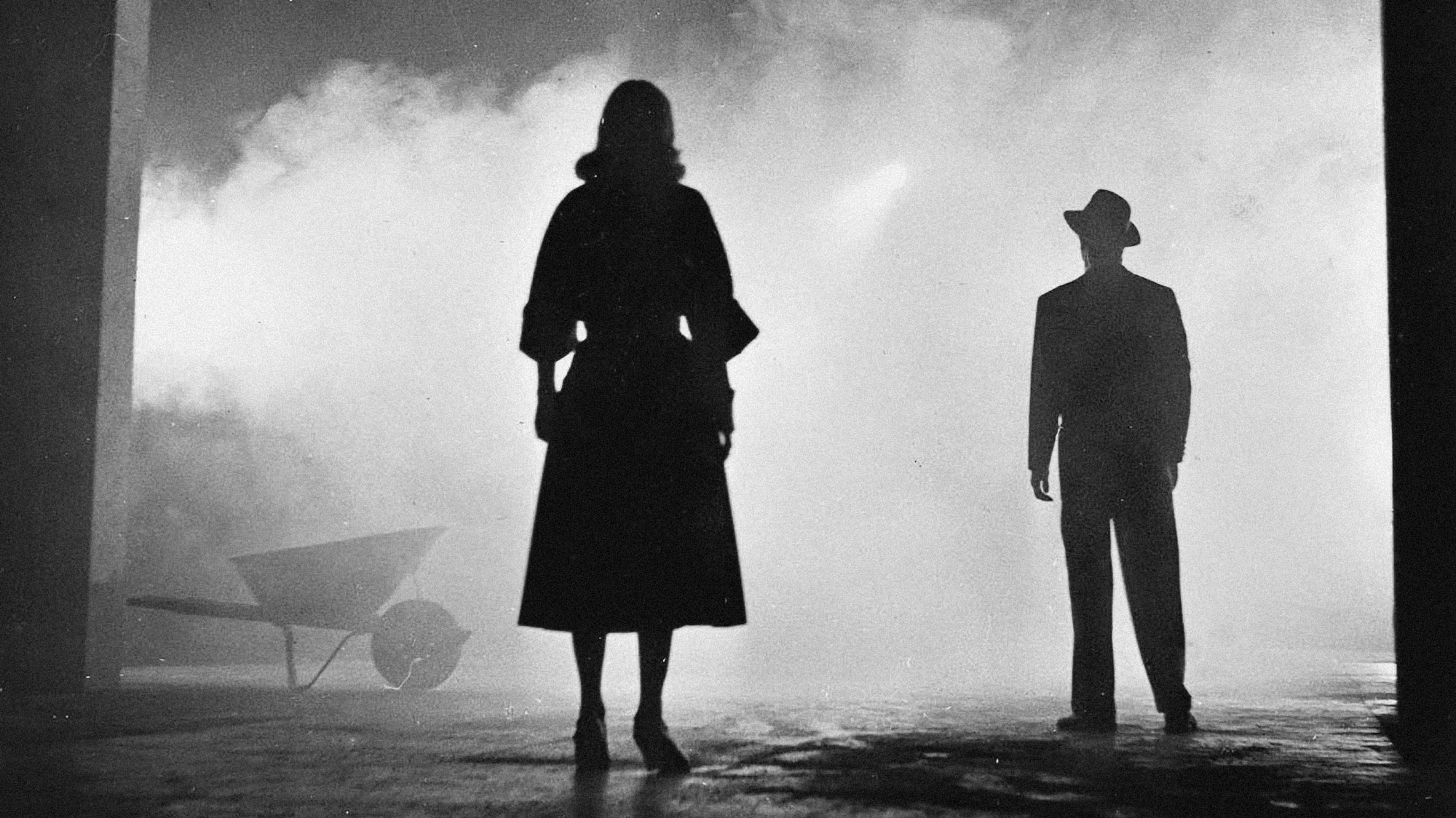
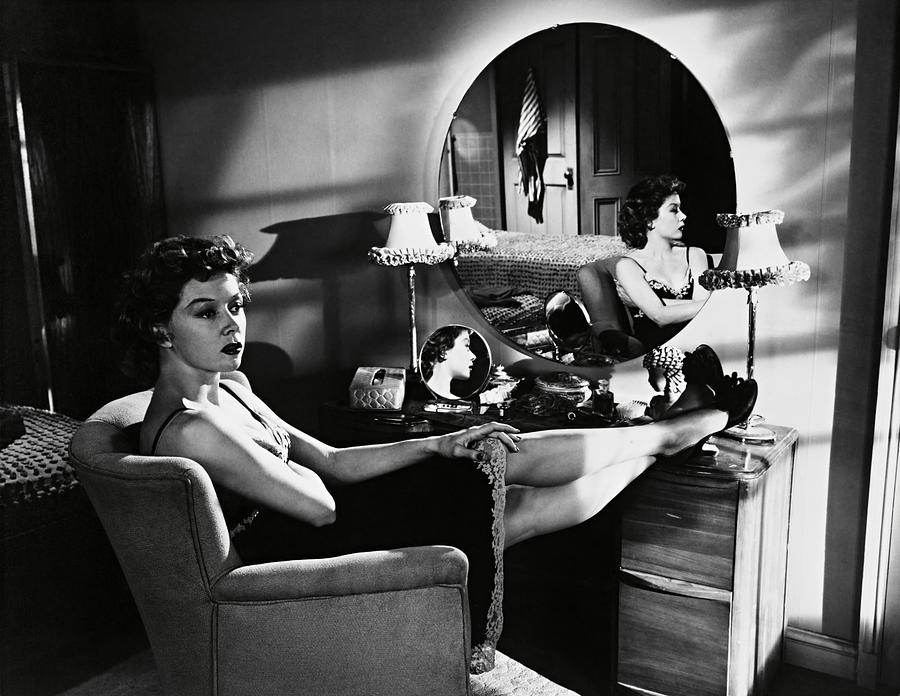
This shot from The Big Combo is considered one of the most iconic images in film noir, by the revered cinematographer John Alton:

This quote is from a chilling scene that starts 55 minutes into the movie, where Cornel Wilde and Jean Wallace (who were married in real life) play a detective confronting the villain’s mistress at a classical concert:

You don’t have to see me again or even speak to me again. But save yourself — leave him!

How?

All you have to do is walk out!

Is that all, Mr. Diamond? You’ve followed me long enough to know I can’t. I live in a maze 
 a strange, blind, and backward maze. And all the little twisting paths lead back to Mr. Brown.

It’s hard to believe that a shot of implied but clear sexual activity (at the end of the scene that begins at 27:15) was allowed in this movie in 1955. The director, Lewis, has explained that the censors confronted him about that scene, but when Lewis asked what the problem was (as if he didn’t know), the censors were too bashful to get specific, so they dropped the issue and left it in the movie!

Click here for the full list of my favorite movie(s) of each year from 1920 to 2020.

my favorite movies of 1954:

(1) Rear Window

(2) La Strada

(3) Dial M for Murder

(4) Human Desire

(5) Sansho the Bailiff

favorite of 1954:

Rear Window

(James Stewart, Grace Kelly, Thelma Ritter, Raymond Burr, Wendell Corey. Directed by Alfred Hitchcock.)

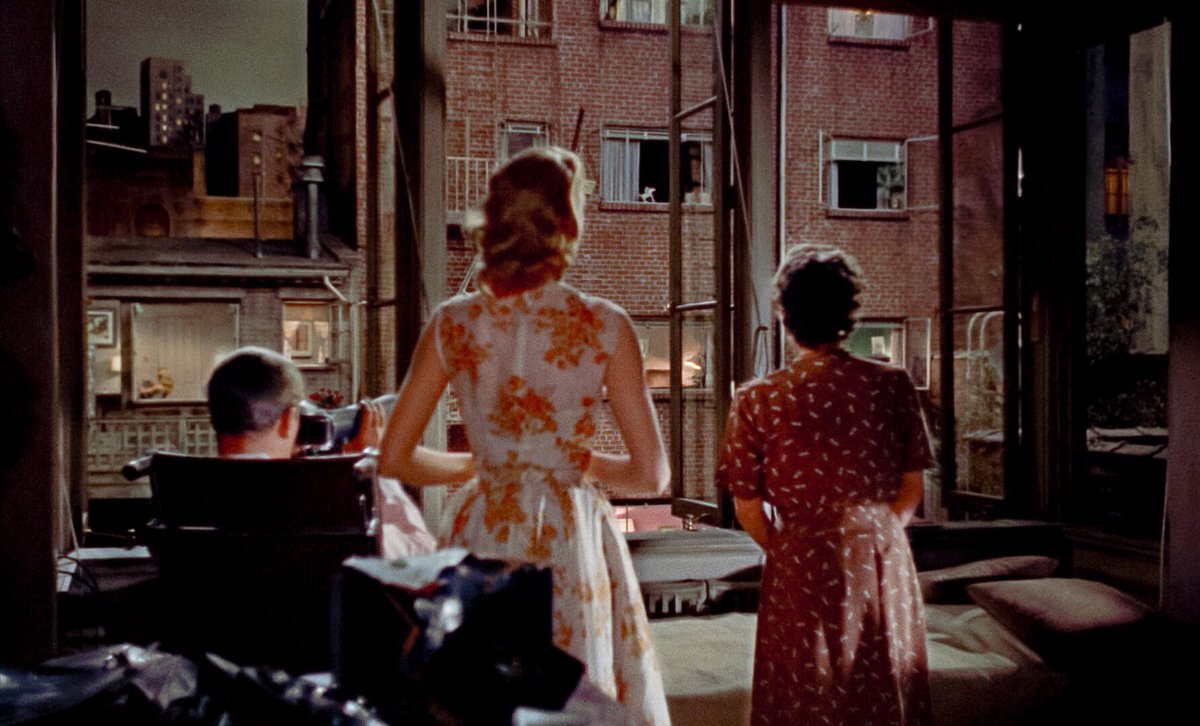
Jimmy Stewart is a photojournalist stuck in his New York City apartment with his leg in a cast, having been injured during a photo shoot. He resists getting engaged to his girlfriend, Grace Kelly, because he finds it hard to imagine her career as a fashion model coexisting with his ruggedly adventurous, globe-trotting lifestyle. But she’ll end up venturing farther than he does when they team up as amateur detectives.

Ebert wrote that “[t]he hero” of Rear Window, by which he meant Jimmy Stewart, “is trapped in a wheelchair, and we’re trapped, too — trapped inside his point of view, inside his lack of freedom and his limited options”:

When he passes his long days and nights by shamelessly maintaining a secret watch on his neighbors, we share his obsession. It’s wrong, we know, to spy on others, but after all, aren’t we always voyeurs when we go to the movies? Here’s a film about a man who does on the screen what we do in the audience — look through a lens at the private lives of strangers.

Ebert was right about the movie’s meta quality but wrong to suggest that there’s only one “hero.”

Stream Rear Window on Amazon Prime or these sites.


2nd favorite of 1954:

La Strada

[Italian, meaning “The Road”]

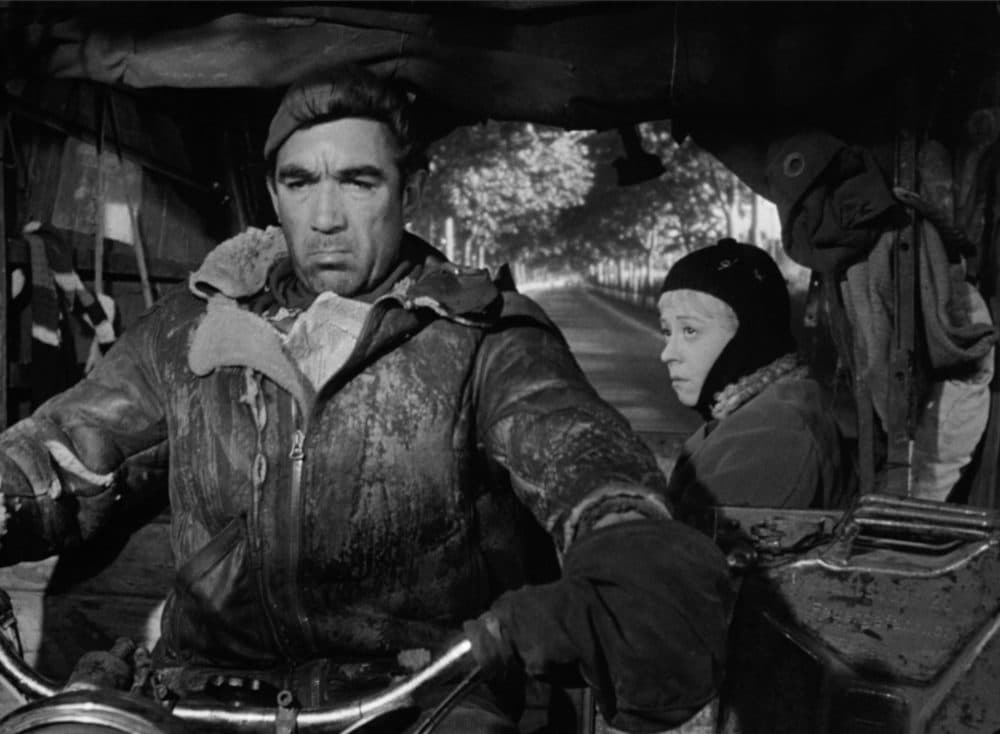
(Giulietta Masina, Anthony Quinn, Richard Basehart. Directed by Federico Fellini.)

Criterion sums up La Strada:

With this breakthrough film, Federico Fellini launched both himself and his wife and collaborator Giulietta Masina to international stardom, breaking with the neorealism of his early career in favor of a personal, poetic vision of life as a bittersweet carnival. The infinitely expressive Masina registers both childlike wonder and heartbreaking despair as Gelsomina, loyal companion to the traveling strongman Zampanò (Anthony Quinn, in a toweringly physical performance), whose callousness and brutality gradually wear down her gentle spirit. … La Strada possesses the purity and timeless resonance of a fable and remains one of cinema’s most exquisitely moving visions of humanity struggling to survive in the face of life’s cruelties.

Stream La Strada on the Criterion Channel (with extras including commentary), Max, or Kanopy. If you don’t subscribe to the Criterion Channel, try free 14-day trial.


3rd favorite of 1954:

Dial M for Murder

(Ray Milland, Grace Kelly, Robert Cummings. Directed by Alfred Hitchcock.)

How do you go about writing a detective story?

Well, you forget detection and concentrate on crime. Crime’s the thing. And then you imagine you’re going to steal something or murder somebody. …

Do you really believe in the perfect murder?

Yes, absolutely — on paper, that is. And I think I could plan one better than most people. But I doubt if I could carry it out.

Oh? Why not?

Well, because in stories things usually turn out the way the author wants them to, and in real life they don’t.

Stream Dial M for Murder on Tubi (free with ads), Kanopy, or these sites.


4th favorite of 1954:

Human Desire

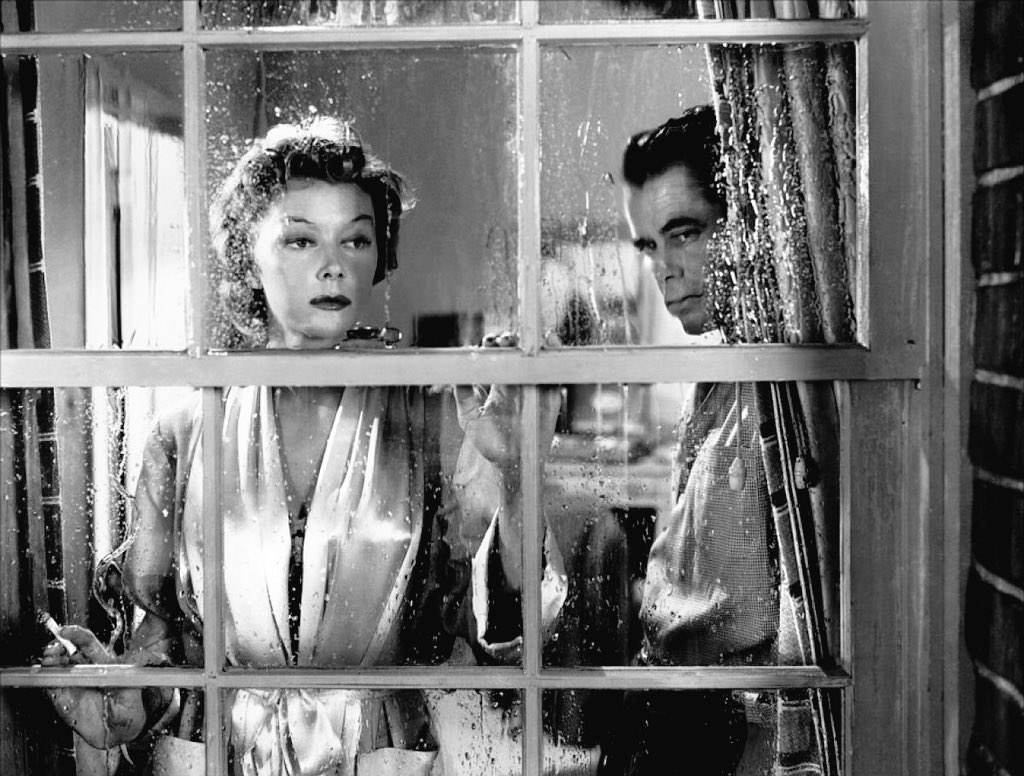
(Gloria Grahame, Glenn Ford, Broderick Crawford. Directed by Fritz Lang.)

This movie has the same leading man and woman and the same director as The Big Heat, one of my favorites from 1953. The Big Heat is far more acclaimed, but I like Human Desire just as much. It has a greater focus on a smaller number of characters, giving it a more stark, personal feel.

This is the fifth movie on my list of “favorite movies from each year of the past 101 years” with a memorable performance by Gloria Grahame. Ebert’s review of The Big Heat includes an appreciation of Grahame which also applies to Human Desire:

her energy is the best reason to see the film. There was something fresh and modern about Grahame; she’s always a little ditzy, as if nodding to an unheard melody. She was … sassy but in a tired and knowing way, and she had a way of holding her face and her mouth relatively immobile while she talked, as if she was pretending to be well-behaved. “It wasn’t the way I looked at a man,” she said, “it was the thought behind it.”

If you’re not familiar with Gloria Grahame from anything other than It’s a Wonderful Life (one of my favorites of 1946), I recommend watching Human Desire, The Big HeatSudden Fear (my favorite of 1952), or In a Lonely Place (one of my favorites of 1950).

Grahame could deliver a great line with a devastating deadpan; she’s the one who said the quotes I’ve chosen from both The Big Heat and Human Desire:

When I first came here, I thought I’d never get used to the trains. Now when it’s quiet, I get nervous.

Stream Human Desire on Tubi (free with ads).


5th favorite of 1954:

Sansho the Bailiff

[Japanese: Sanshō Dayū]     山椒大夫

(Yoshiaki Hanayagi, Kyōko Kagawa, Kinuyo Tanaka, Eitarō Shindō. Directed by Kenji Mizoguchi.)

The premise: “When an idealistic governor disobeys the reigning feudal lord, he is cast into exile, his wife and children left to fend for themselves and eventually wrenched apart by vicious slave traders.”

The New Yorker’s Anthony Lane had a strong reaction:
I have seen [Sansho the Bailiff] only once, a decade ago, emerging from the cinema a broken man but calm in my conviction that I had never seen anything better; I have not dared watch it again, reluctant to ruin the spell, but also because the human heart was not designed to weather such an ordeal. The film itself is a tale of broken men and women, or of those bent to the breaking point by the harrying furies of society. …

Stream it on the Criterion Channel, which has extras including commentary. If you don’t subscribe, try a free 14-day trial. Or rent it on one of these sites.

Click here for the full list of my favorite movie(s) of each year from 1920 to 2020.

my favorite movies of 1953:

(1) Summer with Monika

(2) Gentlemen Prefer Blondes

(3) From Here to Eternity

(4) Stalag 17

(5) Niagara

(6) Sawdust and Tinsel

(7) Dangerous Crossing

(8) The Big Heat

favorite of 1953:

Summer with Monika

[Swedish: Sommaren med Monika]

(Harriet Andersson, Lars Ekborg. Directed by Ingmar Bergman.)

Young fools lovers struggle to go off the grid.

Criterion’s essay on the movie analyzes this wordless but striking scene:

Monika [Harriet Andersson] sits in a café … and, as music rises from the jukebox, turns to stare — in a very long take — directly into the camera. Her open but defiant gaze anticipates the more reflexive distancing devices of Bergman’s films of the sixties, such as Persona (1966), where the female point of view is also central. … The static shot of Monika’s face is scandalously close up, and she looks steadfastly at us, breaking the cinematic illusion, as the screen darkens around her. Such a shot has rarely been seen in cinema, and it was practically unheard-of at the time. Film critic Robin Wood described this moment as almost the only departure from the film’s strict naturalism. Monika’s returning our gaze distances us from the fiction. It also says, “Look at me and judge me if you dare.” …

We may remember that Monika’s vision of escape is motivated by her love of the cinema. … Near the beginning of the film, returning from a night out at the movies with Harry [Lars Ekborg], Monika looks longingly at a blouse in a shop window, after fantasizing about the elegant lives of the movie stars. Her command “You may kiss me now, Harry” echoes words from the film they have just seen. As she says this, the close-up of her brightly lit face against the dark background is similar to the moment in the café when she stares into the camera. She has taken a puff from her cigarette like the star did in the movie she saw with Harry. …
In short, it’s a movie about people who want their lives to be like a movie.

Stream Summer with Monika on the Criterion Channel (with bonus features) or Kanopy. If you don’t subscribe to the Criterion Channel, try a free trial. If you want to own it, you could buy Criterion’s set of 39 Bergman movies in the Barnes & Noble 50% off sale on all Criterion movies, which happens every July and November. I have the set — an amazing deal at less than $4 per blu-ray. (Amazon often lowers its prices at the same time.)


2nd favorite of 1953:

Gentlemen Prefer Blondes

(Marilyn Monroe, Jane Russell, Charles Coburn. Directed by Howard Hawks.)

After watching this musical comedy for the first time, a Bust writer said: “To my pleasant shock, Gentlemen Prefer Blondes is wildly feminist. …”

This movie launched Marilyn Monroe into superstardom. She was billed second, after Jane Russell, but that’s hard to believe when you watch Monroe’s signature song:

Men grow cold / As girls grow old / And we all lose our charms in the end / But square cut or pear shape / These rocks don’t lose their shape / Diamonds are a girl’s best friend

Stream Gentlemen Prefer Blondes on these sites.


3rd favorite of 1953:

From Here to Eternity

(Burt Lancaster, Montgomery Clift, Deborah Kerr, Donna Reed, Frank Sinatra, Ernest Borgnine. Directed by Fred Zinnemann.)

On an Army base in Hawaii in 1941 before the US has entered World War II, soldiers struggle with their own character flaws, with the military, and with women. What’s happening in the characters’ lives and minds in this ensemble drama is as gripping as the looming attack on Pearl Harbor.

From Here to Eternity won a staggering 8 Oscars, including best picture, director, screenplay, supporting actress (Donna Reed), supporting actor (Frank Sinatra), and black and white cinematography. It also might have won best actor if only the vote hadn’t been split by nominations for the movie’s two leading men, Montgomery Clift and Burt Lancaster.

The movie’s most famous scene is the one with Deborah Kerr (who was nominated for best actress) and Burt Lancaster making out on the beach — tame by our standards, but radical for 1953. Of course, From Here to Eternity is much more than that brief scene, which is why I chose the above photo with different actors, Donna Reed and Montgomery Clift. I found them the most interesting people in the movie — and I deliberately put her name first! It’s hard to believe you’re watching the same Donna Reed who played Mary Bailey in It’s a Wonderful Life (one of my favorite moves of 1946).

What’s so great about From Here to Eternity? This video explains (with spoilers):

The video concludes: “It’s one of the unsung classics that demonstrates the real power of films from the Golden Age. When you watch it, you can see why this period was called that.”

Stream From Here to Eternity on these sites.


4th favorite of 1953:

Stalag 17

(William Holden, Sig Ruman, Don Taylor, Otto Preminger, Peter Graves. Directed by Billy Wilder.)

In a German POW camp called Stalag 17, the American prisoners in one compound can’t pull off an escape until they figure out who among them has been betraying the other men by tipping off their German captors.

Most movies are shot out of order to be more convenient and save money, but Stalag 17 was shot in the same order we see it. Director Billy Wilder made that unusual choice so that the actors, who didn’t get to see the whole script at first, would be unaware of who in the POW compound was double-crossing the others until the scenes where we in the audience find out.

William Holden (the one talking in the photo above) won the Oscar for Best Actor for playing J.J. Sefton, whom the other men in the barracks suspect of being the “stoolie” because of his penchant for making trades with the Germans.

Billy Wilder loved to keep things fun and unpredictable by mixing humor into dead-serious subject matter. So Stalag 17 is a dramedy, and this clip gives a taste of the comedy side:


Stream Stalag 17 on Tubi (free with ads), the Roku Channel (free with ads), Kanopy, or these sites.


5th favorite of 1953:

Niagara

(Marilyn Monroe, Joseph Cotten, Jean Peters. Directed by Henry Hathaway.)

Niagara is a rarity in a couple of ways: a film noir in color back in the ’50s, and Marilyn Monroe as a calculating femme fatale.

Stream Niagara on Plex (free with ads) or these sites.


6th favorite of 1953:

Sawdust and Tinsel

(Harriet Andersson, Åke Grönberg, Hasse Ekman, Gunnar Björnstrand. Directed by Ingmar Bergman.)

Sawdust and Tinsel is an early example of Ingmar Bergman’s fascination with a theme he’d keep returning to in later movies: humiliation.

The ringleader of a circus (Åke Grönberg) and his mistress (Harriet Andersson) are dissatisfied with their lives in the circus, and with each other.

After the circus has a setback, the two of them go to a theater and beg its director (Gunnar Björnstrand) for aid, while both overdressed in their classiest attire. The director lashes out at the couple in front of actors who are in the middle of a rehearsal. When the ringleader asks why he’s being so insulting, the director’s answer captures the movie’s themes of humiliation, contempt, and dominance:

We make art; you make artifice. The lowest of us would spit on the best of you. Why? You only risk your lives. We risk our pride.

This video gives an insightful analysis of Sawdust and Tinsel (from Learning About Movies, a YouTube channel by Dr. Josh Matthews). He says to watch for these contrasts when you watch the movie: appearance vs. reality, dynamic vs. static, high art vs. low art, art vs. the state, male vs. female, boss vs. clown, humans vs. animals, work vs. leisure, and glamour vs. humiliation.

Stream Sawdust and Tinsel on the Criterion Channel (with extras including commentary), Max, or these sites. (If you don’t subscribe to the Criterion Channel, try a free trial.)


7th favorite of 1953:

Dangerous Crossing

(Jeanne Crain, Michael Rennie, Carl Betz. Directed by Joseph M. Newman.)

This gaslight noir starts with a newlywed couple overjoyed to be on their honeymoon on an ocean liner. Of course, they won’t stay happy for long: Ruth (Jeanne Crain) suddenly can’t find her husband, John (Carl Betz), and everyone else acts like she’s crazy when she can’t prove that she’s married, or that John even exists. Then Ruth gets a call warning her that she and her husband are both in serious danger …

I don’t know anywhere to stream Dangerous Crossing, but you can check here.


8th favorite of 1953:

The Big Heat

(Glenn Ford, Gloria Grahame, Lee Marvin, Jocelyn Brando. Directed by Fritz Lang.)

At first I wasn’t sure what to make of this film noir with numerous characters and an elaborate plot. Ebert’s review crystallized it for me: “[Fritz Lang] tells the story of a heroic cop [Glenn Ford], while using it to mask another story, so much darker, beneath. …”

Gloria Grahame is the standout, and she has the best line:

I guess the scar isn’t so bad — not if it’s only on one side. I can always go through life sideways.

Stream The Big Heat on the Roku Channel or these sites.

Click here for the full list of my favorite movie(s) of each year from 1920 to 2020.