(Louise Brooks, Fritz Körtner, Francis Lederer, Alice Roberts. Directed by G.W. Pabst.)
Even if you generally avoid spoilers, I recommend reading Ebert’s review (or Wikipedia’s plot summary) before watching Pandora’s Box for the first time, so you won’t be distracted by the rather silly story and can instead focus on the movie’s overall atmosphere. Ebert said the plot “could apply equally to a great or a laughable film,” but Louise Brooks “makes it a great one.” Ebert explained:
She seems to stand outside “Pandora’s Box.” She looks modern: She doesn’t have the dated makeup of many silent stars, but could be a Demi Moore or Winona Ryder, electronically inserted into old scenes by computer. As she careens from one man to another, the only constant factor is her will: She wants to party, she wants to make love, she wants to drink, she wants to tell men what she wants. … There is no other motive than her desire: Not money, not sex, just selfishness.
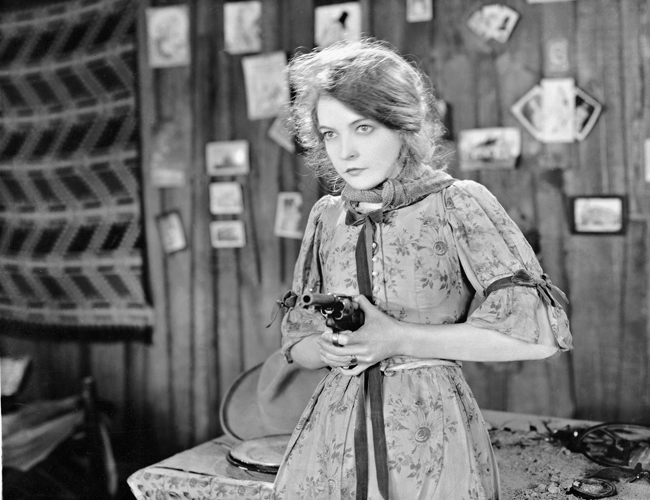
The Wind(Lillian Gish, Lars Hanson, Montagu Love. Directed by Victor Sjöström.)
Another tour de force for Lillian Gish (see my favorite movie of 1920). Not only is she in almost every scene of The Wind, but she also chose the novel the movie was based on, wrote the story outline, and hand-picked the director and leading man.
When Gish finds herself unhappily married, lonely, and stuck at home in a remote area of Texas, a furious wind becomes a metaphor for her mental health spiraling out of control:
The silent film form itself was about to become extinct, and perhaps its greatest “Western” came just before the end. The quotes are necessary because … The Wind is more a psychological study that just happened to be set in the West. Yet it contains elements central to so many Westerns[:] human isolation in a vast landscape, the alienation of the woman in Western society, and the brutal indifference of nature. … The Wind is perhaps the purest expression of a rare form, a woman’s fantasy of life in the West, in a genre dominated almost exclusively by male fantasies.
Lillian Gish, who lived to be 99 (1893-1993), looked back on her extraordinary acting career, which lasted from 1912 to 1987, and said: “The Wind was definitely my most uncomfortable experience in pictures.” (She says that in the video below, which includes a mild spoiler about the ending from 2:20 to the end of the video.)
Watch the whole thing here (in the public domain):
At the first Oscars, before they decided to give a single “Best Picture” award, this movie won an award that was never given again: “the Academy Award for Unique and Artistic Picture.”
Ebert’s review says a lot about the camerawork in Sunrise: A Song of Two Humans, which broke through technical limitations of the time by moving around with a new freedom. Ebert adds:
The story … is very simple, but it has power. The woman from the city persuades the man to drown his wife so they can run away together. The film has few titles, but they are dramatic: the word “drown” swims into view and then appears to run down the screen and disappear. …
It’s very broad melodrama, and the realism of spoken dialogue would have made it impossible. But silent films were more dreamlike, and Murnau was a genius at evoking odd, disturbing images and juxtapositions that created a nightmare state. Because the characters are simple, they take on a kind of moral clarity, and their choices are magnified into fundamental decisions of life and death. … The more you consider “Sunrise” the deeper it becomes — not because the story grows any more subtle, but because you realize the real subject is the horror beneath the surface.
2nd favorite of 1927:
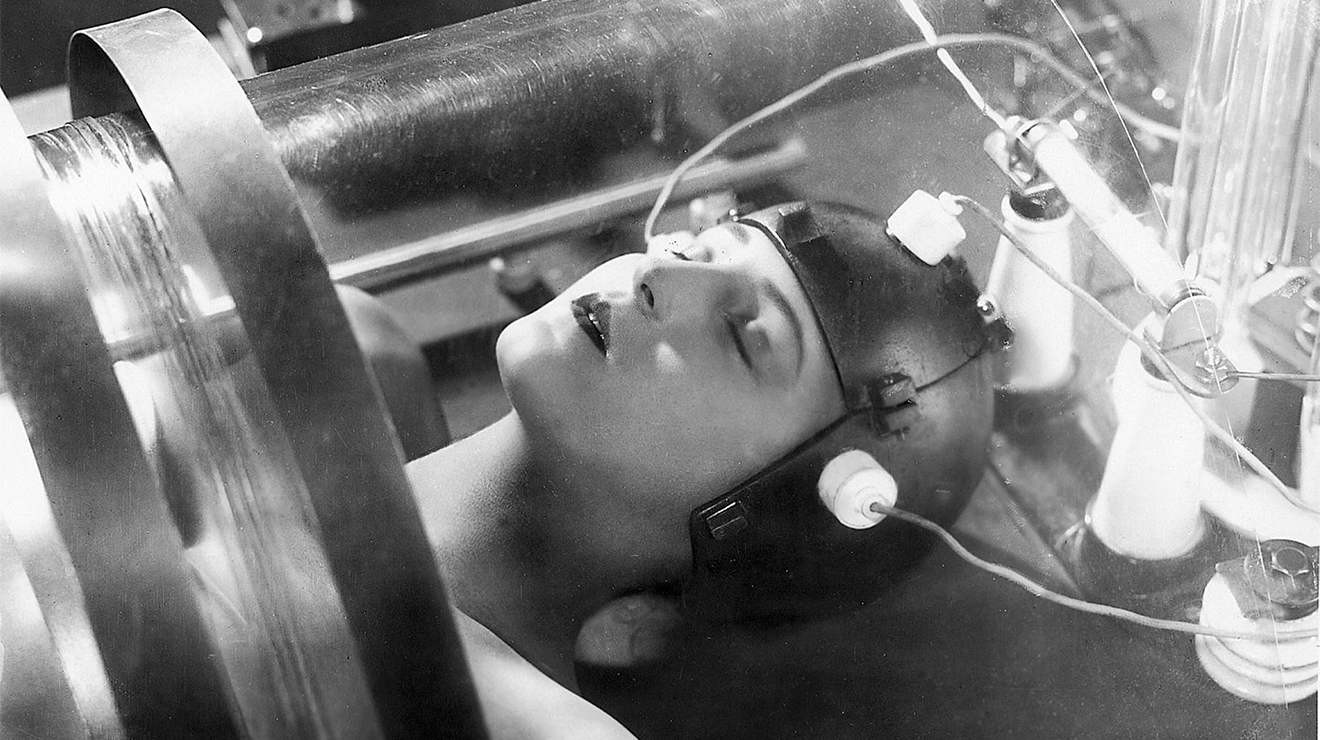
Metropolis(Brigitte Helm, Gustav Fröhlich, Alfred Abel, Fritz Rasp. Directed by Fritz Lang.)
Watch the whole thing here (in the public domain):
Lang created one of the unforgettable original places in the cinema. “Metropolis” fixed for countless later films the image of a futuristic city as a hell of material progress and human despair. … The laboratory of its evil genius, Rotwang, created the visual look of mad scientists for decades to come. … The device of the “false Maria,” the robot who looks like a human being, inspired the Replicants of “Blade Runner” [1982].
More analysis:
3rd favorite of 1927:
The Unknown(Lon Chaney, Joan Crawford, Norman Kerry, John George. Directed by Tod Browning.)
Watch the whole thing here (in the public domain):
Joan Crawford is a circus performer who can’t stand men’s hands, while Lon Chaney plays an armless knife thrower.
4th favorite of 1927:
The Kid Brother(Harold Lloyd, Jobyna Ralston, Walter James, Constantine Romanoff, Eddie Boland, Josephine the monkey. Directed by Ted Wilde, J.A. Howe [uncredited director: Lewis Milestone].) That video from Criterion focuses on Harold Lloyd’s climactic confrontation with the villain:
Wrestler Constantine Romanoff is ugly, malign, and powerful. It’s a shock to see him in the same frame as the sweet Harold — he barely seems to belong in the same film or genre. Harold’s inoffensiveness doesn’t seem bland in this context, but rather the light balancing the dark. Something about a climate of fear is conducive to laughter; there’s a deep, mysterious connection. Horror films and comedies both achieve their effects by building and then releasing tension. … Lloyd was a master at wringing laughs from fear. That’s where the monkey comes in. …
Watch the whole movie here (in the public domain):
Or you can stream a higher-quality version of The Kid Brother on the Criterion Channel, which has extras including commentary. (If you don’t subscribe, try a free trial.)
The General(Buster Keaton, Marion Mack. Directed by Keaton, Clyde Bruckman.)
Wikipedia explains that this movie was such a flop at the time that MGM punished Buster Keaton by taking away his independence — but today it’s considered his greatest achievement. Orson Welles said The General was “the greatest comedy” and “perhaps the greatest film ever made.”
“The General” is an epic of silent comedy, one of the most expensive films of its time, including an accurate historical recreation of a Civil War episode, hundreds of extras, dangerous stunt sequences, and an actual locomotive falling from a burning bridge into a gorge far below. It was inspired by a real event;
the screenplay was based on the book “The Great Locomotive Chase,” written
by William Pittenger, the engineer who was involved.
As the film opens, war has been declared and Johnny Gray (Keaton) has been turned
down by a rebel enlisting officer (he is more valuable as an engineer, although
nobody explains that to him). “I don’t want you to speak to me again until you
are in uniform,” Annabelle [Marion Mack] declares. Time passes. Johnny is the engineer of the
General, a Southern locomotive. The train is stolen by Union spies, and Johnny
chases it on foot, by sidecar, by bicycle and finally with another locomotive,
the Texas. Then the two sides switch trains, and the chase continues in
reverse. Annabelle was a passenger on the stolen train [and] becomes a prisoner of
the Union troops. …
It
would seem logically difficult to have much of a chase involving trains, since
they must remain on tracks, and so one must forever be behind the other
one — right? Keaton defies logic with one ingenious silent comic sequence after
another, and it is important to note that he never used a double and did all of
his own stunts, even very dangerous ones, with a calm acrobatic grace. The
train’s obvious limitations provide him with ideas. …
You can watch the whole thing here (in the public domain):
(Nadia Sibirskaïa, Yolande Beaulieu, Guy Belmont. Directed by Dimitri Kirsanoff.)
It’s hard to believe this short movie with dream-like editing and subtle emotion came out as long ago as 1926. With no words either spoken or written, the movie can sometimes be hard to follow, especially as it begins with a disorienting scene of sudden violence. Still, Pauline Kael said it was her favorite movie ever. Another critic, Ed Howard, said:
Ménilmontant is a masterpiece of silent cinema, taking a simple melodramatic plot and transforming it into a deeply affecting work of art with the sheer force of the poetic, intense visuals that Kirsanoff uses to tell his story. The film follows a pair of sisters who leave the country for the city after their parents are slaughtered in a mysterious axe murder. Unusually for the time, there are no intertitles, so the plot is communicated entirely with imagery. This economical storytelling gives the film a lean, stripped-down aesthetic that makes it seem eminently modern.
[Chaplin] was spurred by reading a book about the tragic Donner Party of 1846–47, and then by looking through Douglas Fairbanks’s collection of stereoscope cards, which included a series on the Klondike Gold Rush of 1897–99. … Chaplin’s Tramp is here called the Lone Prospector, his costume unaltered except for the knapsack on his back, with attached pickax and frying pan. …
The essay goes on to sum up the movie’s highlights — for instance:
When the Lone Prospector is starving in the cabin with Big Jim, he resorts to boiling his shoe. After sacrificing the upper to Jim, he makes his own meal of the sole, nails, and laces, rolling the laces on his fork like spaghetti and relishing each individual nail as if they were the bones of a quail. …
And when the Lone Prospector falls asleep waiting for Georgia and her friends to come over for New Year’s Eve dinner, he dreams of entertaining them with a soft-shoe dance staged with rolls impaled on forks. …
And there is so much else. No one who has seen the picture can easily forget the cabin, come to rest on the lip of a chasm, teetering back and forth as Charlie and Big Jim move from one side to the other within. …
You can watch the whole movie for free here (in the public domain):
You can also stream The Gold Rush on the Criterion Channel, which has lots of extras including commentary, and Chaplin’s 1942 version of the movie with added narration. (If you don’t subscribe, try a free 14-day trial.)
Girl Shy (Harold Lloyd, Jobyna Ralston. Directed by Fred C. Newmeyer.)
Harold Lloyd writes a book about how to succeed with women based on his fantasies, while in reality he can barely get through one sentence to a woman. The movie amusingly manages to show his stuttering problem without any sound.
Watch the whole thing here (in the public domain):
Safety Last!(Harold Lloyd, Mildred Davis, Bill Strother. Directed by Fred C. Newmeyer, Sam Taylor.)
Harold Lloyd hanging from a clock on a building in Safety Last! inspired the scene of Back to the Future (my favorite movie of 1985) where Doc (played by Christopher Lloyd — no relation) hangs from the Hill Valley clock tower. That scene is foreshadowed at the very beginning of Back to the Future before any characters speak, when we see Doc’s messy lab with a sprawling clock collection that includes a miniature of … Harold Lloyd hanging from the clock in Safety Last! (That’s right at the beginning of this video.)
You can watch Safety Last in the YouTube video above, or stream it on the Criterion Channel, which has lots of extras including commentary. (If you don’t subscribe, try a free 14-day trial.)
2nd favorite of 1923:
Our Hospitality(Buster Keaton, Natalie Talmadge, Joe Roberts. Directed by Keaton, John G. Blystone.)
Due to a longstanding feud between the Canfields and the McKays (a satire of the real-life feud between the Hatfields and the McCoys), the Canfield patriarch and his sons want to kill a young and naive McKay (Buster Keaton), but the Canfields’ moral code of Southern hospitality won’t allow them to kill him as long as he’s in their house. Keaton ends up performing some daring acts, never using a stunt double.
“Our Hospitality” is Keaton’s first feature as auteur and his first masterpiece. … It isn’t his fastest, funniest or most dazzlingly inventive picture … but it is my sentimental favorite because of its serene, nostalgic beauty — a vision of a halcyon world (America, circa 1830) that was already, of course, charmingly old-fashioned by 1923 standards. …
The journey of the Out-Bound Limited from New York to Appalachia is one of my favorite passages in all of cinema. It’s like a memory inside a dream: a locomotive that looks like an antique children’s toy (but is, in fact, a replica of the 1829 Stephenson’s Rocket, an early steam engine), pulling a string of what look like eccentric stagecoaches outfitted for rail conveyance. Keaton loved trains, and while “Our Hospitality” can be seen as a forerunner of “The General” [1926] … this vehicle is not one of the powerful, speeding behemoths of Keaton’s Civil War-era epic. Instead, the OBL rolls along at a leisurely pace (slow enough that [Keaton’s] dog can walk between its wheels), which is a good thing because whoever put down the tracks lazily draped them right over any logs and boulders that got in the way. …
“Our Hospitality” … displays some magnificent pictorial compositions, worthy of John Ford: the Out-Bound Limited seen from under a silhouetted outcropping of rock; Keaton scampering across a mountain, with a hazy valley stretching out below him. Again and again Keaton will place the camera in the most natural and unobtrusive place and then, in the course of the shot, allow reality to reveal itself in all its wonder — whether it’s looking down a tangle of railroad tracks at the possible trajectories available; or spying an absconder in drag from the rear; or peeking through a bedroom door. … What is first viewed through the frame is not always what it appears to be. But these aren’t just tricks or sight gags (though they’re often really funny); they are the very fabric of Keaton’s constantly transforming cosmos.
Day Dreams(Buster Keaton, Renée Adorée. Directed by Keaton, Edward F. Cline.)
Buster Keaton wants to marry a woman whose father (played by Keaton’s real-life dad) wants to know how he’ll support her … so Keaton announces that he’ll either get a job or shoot himself!
You can watch this 22-minute short here (or stream it on the Criterion Channel):
Wikipedia tells us the movie is “most famous for a scene where Keaton finds himself on the inside of a riverboat paddle wheel” and “has to run to get out of it.”
The Kid(Charlie Chaplin, Jackie Coogan, Edna Purviance. Directed by Chaplin.)
For anyone who isn’t very familiar with the silent era, Chaplin’s first full-length movie would be an ideal introduction. A hundred years later, the comedy and drama of The Kid can still reach us directly.
You can stream it on the Criterion Channel, with bonus features. (If you don’t subscribe, try a free 14-day trial.) Or you can watch the whole movie free on Vimeo here:
We talk about “old movies,” but I like to think of movies that come out today as “old,” because they come from an industry that’s been around for over a century. I’d rather talk about movies from the 1920s as “young movies.” It can be exciting to see the medium in its youth, when the whole idea of a movie was more fresh and new, not as weighed down by the accumulation of influences and expectations.
Way Down East(Lillian Gish, Richard Barthelmess, Lowell Sherman. Directed by D.W. Griffith.)
Lillian Gish was called the “First Lady of American Cinema,” and you can see why in this movie. She has a captivating screen presence that transcends the typical overacting of the silent era.
You can watch the whole movie here (in the public domain):
Unfortunately, at two and a half hours, Way Down East should have been cut way down! Forgettable comic subplots get in the way of the main story, in which Gish gets conned into a sham marriage and has an unplanned pregnancy.
The stunning climactic scene out in nature was done without stunt doubles (as described in this article), causing Gish’s hand to be permanently injured.